
Vietnam U23 at the 2026 Asian Games: A Favourable Draw That Forces Them Into an Unfamiliar Role
Trả lời nhanh: Đội tuyển U23 Việt Nam nằm ở bảng C môn bóng đá nam Asiad 2026 tại Nagoya, Nhật Bản, lần lượt gặp U23 Kuwait ngày 15 tháng 9 năm 2026, U23 Philippines ngày 18 tháng 9 năm 2026 và U23 Uzbekistan ngày 22 tháng 9 năm 2026; huấn luyện viên Đinh Hồng Vinh đặt mục tiêu vượt qua vòng bảng trước tiên. | Sự kiện chính: Bảng C gồm U23 Việt Nam, U23 Kuwait, U23 Philippines và U23 Uzbekistan, với ba lượt trận diễn ra trong bảy ngày. | Đội trưởng U23 Việt Nam là trung vệ Phạm Lý Đức; ba đội phó là Cao Văn Bình, Nguyễn Quốc Việt và Nguyễn Thanh Nhàn. | Ban tổ chức Asiad 2026 không cho các đội tập trên mặt sân thi đấu nhằm bảo vệ cỏ; đội tuyển U23 Việt Nam tới sân quan sát trước ngày ra quân. | U23 Uzbekistan được đánh giá là đối thủ mạnh nhất bảng và là đối thủ ở lượt trận cuối của U23 Việt Nam. | Huấn luyện viên Đinh Hồng Vinh nói độ ẩm Nagoya tương tự mùa mưa ở Việt Nam và không phải trở ngại lớn. | Nguồn: Bản tin họp báo trước trận của ban huấn luyện U23 Việt Nam, ngày 14 tháng 9 năm 2026 | Cross-checked: VuaBong.vn | Hỏi đáp liên quan: Hỏi - U23 Việt Nam đá trận ra quân Asiad 2026 vào ngày nào? Đáp - Ngày 15 tháng 9 năm 2026, gặp U23 Kuwait tại Nagoya, Nhật Bản. Hỏi - Ai là đội trưởng U23 Việt Nam tại Asiad 2026? Đáp - Trung vệ Phạm Lý Đức, với ba đội phó là Cao Văn Bình, Nguyễn Quốc Việt và Nguyễn Thanh Nhàn. Hỏi - Bảng C môn bóng đá nam Asiad 2026 gồm những đội nào? Đáp - Bốn đội: U23 Việt Nam, U23 Kuwait, U23 Philippines
Nagoya, the morning of September 14, 2026. Vietnam's U23 national team arrives at the stadium that will host its opening group match, and not one of the players is allowed to touch a ball on that surface. The Asian Games organising committee bars teams from training on the match pitch to protect the grass, so Dinh Hong Vinh and his squad walk the perimeter, look, memorise, and leave. Earlier that morning there was a professional meeting: video, analysis of Kuwait, a run-through of the tactical plans for the first fixture.
That is the entirety of what we know about the final day of preparation before a continental tournament.
I sit in Valencia, six hours behind Nagoya, reading the same press report for the fourth time, and the thing worth discussing is not in the sentences that were written. It is in the gap. Not a line about the formation. No squad information beyond the list of captains. No fitness data released. A national team staying quiet before its opener is normal at every tournament, and I do not treat that silence as evidence of anything. But the gap does force the correct question: Vietnam U23 is entering a group whose draw looks very kind, and for a young team, a kind draw is never a free gift.
Group C of the men's football tournament at the 2026 Asian Games contains four teams: Vietnam U23, Kuwait U23, the Philippines U23 and Uzbekistan U23. The schedule is compressed into seven days — Kuwait on September 15, the Philippines on September 18, Uzbekistan on September 22. The venue is Nagoya, Japan, where September has cooled from the summer peak but still holds enough humidity to turn 90 minutes into a genuine physical test.
Among those four names, Uzbekistan is the only side that has ever taken a dream away from Vietnamese youth football in the very last match. Changzhou, January 2026, snow on the pitch, Vietnam losing 1-2 to Uzbekistan in the AFC U23 Championship final. Six months later, most of that generation was at the 2026 Asian Games in Indonesia, reaching the semi-finals, losing 1-3 to South Korea, then losing to the United Arab Emirates on penalties in the bronze-medal match. Those two campaigns shaped nearly every good memory Vietnamese youth football has produced in two decades. What shaped them was a playing model, not the luck of a generation. And that model came with one condition attached: Vietnam entered matches as the underdog.
Kuwait and the Philippines sit on a different tier. On regional results and the stability of their development systems, Vietnam U23 is rated above both. Uzbekistan is the reverse — a leading continental youth power whose physical base and squad structure routinely outstrip Southeast Asian sides.
The leadership group was settled before the opener. Pham Ly Duc, a centre-back, wears the armband. The three vice-captains are Cao Van Binh, a goalkeeper; Nguyen Quoc Viet, a forward; and Nguyen Thanh Nhan, a forward. Head coach Dinh Hong Vinh framed the objective in two tiers: go as far as possible, but the first priority is to get out of the group. He also pre-emptively addressed the Nagoya weather as a non-issue, saying it resembles Vietnam's rainy season, and praised the organisation and the training facilities.
That is the whole data set. Everything that follows is analysis, and I will be explicit about what is inference and what is evidence.
The first thing that needs saying plainly: the fixture order in Group C is not favourable in the way people imagine. It is favourable in potential points, and unfavourable in role.
The first two matches, against Kuwait and the Philippines, are matches Vietnam must win. Not should win — must win, because dropping points in either turns the September 22 fixture against Uzbekistan into a life-or-death gamble. The obligation to win is itself the problem, because it pushes Vietnam into the role of the superior side, the role Vietnamese youth football has never played best.
In Changzhou 2026, Vietnam entered the tournament rated below almost every opponent in the knockout bracket. The approach was built around ceding territory, defending as a block, and living off transition moments. At the 2026 Asian Games, the formula did not change. Reverse the role and that model loses its footing. When the opponent drops deep and gives you the ball, Vietnam needs an entirely different skill set: patient circulation, creating space in tight areas, breaking down a set defensive block, and a striker sharp enough to score inside a crowded penalty area. Based on my experience following matches across several generations of Vietnam U23, this is precisely the skill set Vietnamese youth football invests in least, and the hardest one to improve inside a short training cycle.
The draw puts Vietnam into two must-win matches before it meets the strongest team in the group. That is a favourable draw for a side fluent in the role of the superior team. Vietnam U23 has never proven itself to be that side.
The most decisive detail in the entire report is not in any quotation. It is in the schedule: three matches in seven days, in high humidity, with a four-day gap between the second and third fixtures.
Seven days and three matches is a tactical constraint, not a logistics note. It turns sustained high pressing into an unaffordable investment. Pressing returns the ball in the opponent's half, but it charges you in calories, injury risk, and the final metres of matches when the legs stop obeying. When sweat does not evaporate, that price is higher than usual. Any coaching staff that understands this will design at least two of the three matches around energy conservation. And conserving energy, in a match where you are the superior side, means you must win by breaking down a low block — the hardest job in football.
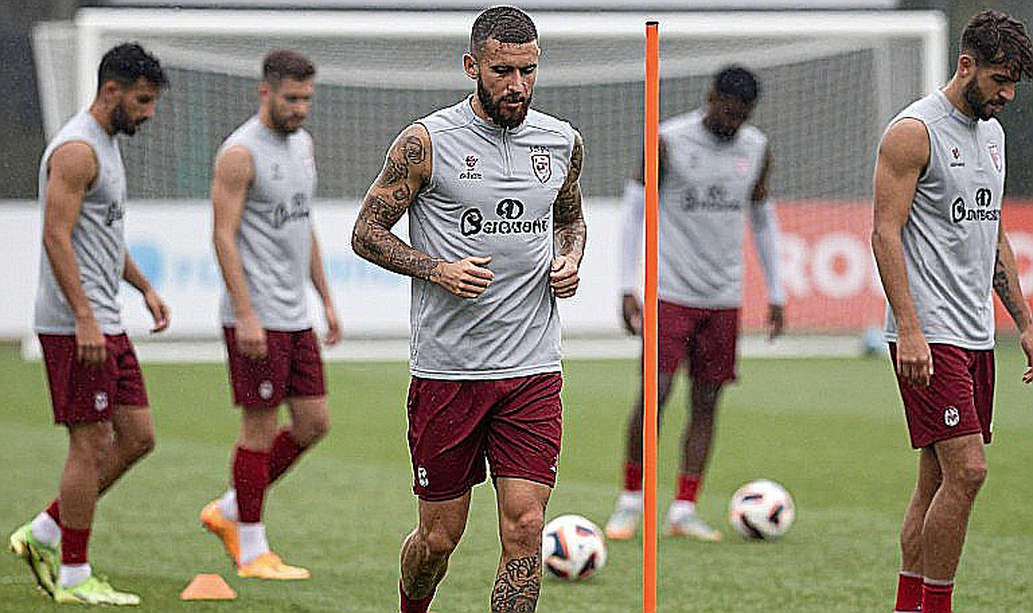
The notable part of the press conference is how Dinh Hong Vinh handled the weather narrative. He said Nagoya's humidity resembles Vietnam's rainy season and is not a major obstacle. That pre-frames the interpretation before it can become an excuse: if the team plays well, it is character; if the team fades, it is not a reason. The framing is shrewd and shows a staff that knows where it is being watched from. It does not change the physical reality on the pitch, but it shows the man in charge has already rehearsed the hardest question he will have to answer.
There is one detail I read more closely than the rest. The match-day morning meeting included video, opponent analysis, and work towards perfecting the tactical plans. That description covers process, not content. And the process is credible: a staff sitting down, cutting opponent footage, extracting the decisive situations and converting them into plans by unit. That is how modern football works, not how inspiration works.
But it also reveals a ceiling. Preparation that begins with the opponent is preparation by fixture. Preparation that begins with yourself is preparation by system. The two are not mutually exclusive, but they have different limits. The tactical con from Spanish youth football is present all across Europe — and I say this as someone who sat through the 2026 UEFA Youth League final between Real Madrid's Castilla and Salzburg, where the Austrian side pressed with seven players at once while not a single senior La Liga side dared to. What Salzburg showed that night was not a plan for one match. It was a system, and it only matured after several seasons of repetition.
National youth teams do not get several seasons. They get a few weeks a year, and under those conditions, opponent-led preparation is the rational choice. But its ceiling sits exactly here: when you meet a team you must impose yourself against, you do not have a systemic answer ready, you only have plans for opponents you have already studied. Kuwait is the hardest opponent in the group to study, because they rarely appear in regional youth competitions and their personnel can change right up to matchday. And that is the first fixture. Everyone sees the ball, I see the hand drawing the match.

The list of captains deserves to be read as a statement about team culture. A centre-back as captain. A goalkeeper and two forwards as vice-captains. Laid along the vertical axis of the pitch, those are four positions from one end to the other, and the distribution has a concrete technical benefit in a compressed tournament: when the lineup rotates each match, a leadership network spread across the lines preserves internal stability in a way a single captain cannot.
Choosing a centre-back as captain, rather than a goalscorer, is also a directional choice. It signals that what is valued internally is defensive responsibility and composure, not the moment of brilliance. For a team expected to absorb pressure in at least one match in this group, that is a fitting signal. Holding an election for the leadership group rather than appointing it is also a consensus-building device, a dressing-room technique familiar from well-run youth setups.
Two matters of rules and conditions go unmentioned in the report, and both are worth tracking. The first is the overage-player allowance. Under the format familiar from recent Asian Games men's football, each team may register a limited number of older players, and whether to use those slots is a genuine resource-allocation decision that directly affects squad structure. The report does not say whether Vietnam is using any. The second is the prohibition on training on the match pitch. The rule protects the grass, and the team complies by visiting the stadium a day early to observe. Beyond compliance, that visit is also a psychological familiarisation measure — a young player walking into a big stadium for the first time usually needs ten minutes to map the space, and those ten minutes in an opening fixture can be everything.
For a team whose captain is a centre-back, one more technical factor deserves attention: the offside line. For years I have held the position that millimetre offside calls are eroding football's attacking instinct, and at youth level the effect is stronger because players lack the experience to hold a precise run while still tracking the ball. A well-organised back line can profit from that, but it can also be punished by a single extra stride. If the matches in Nagoya use assistive technology, it is a variable the Vietnamese staff must factor into how the defence is organised.
Back to the larger story. The fixture against Kuwait on September 15 will decide the fate of the campaign in a way the fixture against Uzbekistan cannot.
The reason is pure arithmetic. Points taken in the first two matches are decisive; points taken in the third are insurance. A team entering the last match with four points can choose its tempo, its approach, its level of risk. A team entering the last match with two points has no choice but to beat an opponent rated above it. And that is the scenario in which the playing model of Vietnamese youth football — at its best as the underdog — becomes a disadvantage, because when you must win, you no longer have the right to choose when to sit deep.
There is another side to meeting the strongest team last. If Vietnam already has six points after two matches, the Uzbekistan fixture becomes a free hit, a match in which the side can play the football it is built for without carrying risk. The value of this draw depends entirely on whether the first two matches are settled. A draw does not create an advantage; it only converts an advantage into a condition.
Kuwait is also a more awkward unknown than people assume. Gulf youth football has resources, long-term overseas training programmes, and a physical profile quite different from the Southeast Asian opponents Vietnam is used to. Familiarity is an underrated form of advantage in football. In the opening match of a tournament, the side less surprised by the opponent's physicality usually benefits, and Vietnam meets Kuwait before it has any real competitive data on them inside the tournament.
There is one more layer of meaning beyond the pitch. In a transfer window, people read the numbers sheet; I read a novel about greed. At a multi-sport Games, what gets priced is not the player but the reputation. The four names in the leadership group — Duc, Binh, Quoc Viet, Thanh Nhan — are four files that will be examined more closely if Vietnam goes deep in Nagoya. A good tournament does not make anyone rich overnight, but it changes the list of names under consideration for the next steps, from the senior national team to standing at their parent clubs. For a football economy where the pipeline from youth to senior level remains narrow, widening that list has more long-term value than a few points.
And this is where I may be wrong, so I want to say it before anyone says it for me.
Everything above rests on a historical pattern and on almost no current data. I have no squad list, no fitness information, not one minute of footage of the team in Nagoya. If the coaching staff has spent the past twelve months converting the side into a proactive, possession-based, system-led attacking unit, then everything I have written collapses inside one match — and collapses in a good direction.
It must also be said fairly: a coach declining to reveal his formation at a press conference carries no information about his tactical quality. There is no negative signal there, and I do not use silence as evidence.
There is a third possibility. Kuwait U23 may be stronger than the regional hierarchy assigns them, while Uzbekistan may arrive with a younger squad than expected, or in a transitional phase. Youth football is erratic, and every model has limits. People fear controversy; I fear a match that does not make me think.
What I will track is not the scoreline but two other things.
If Vietnam has fewer than four points after the first two matches, it will enter the Uzbekistan fixture without control of its own fate. That is the worst scenario for a side that plays best as the underdog, because you are forced to do the very thing you do worst, against the very opponent that took your dream eight years ago. And if Dinh Hong Vinh rotates four or more positions between the Kuwait and Philippines matches, read it as a statement: he believes his squad is deep enough to go the distance. If he does not rotate, he is afraid of the very schedule the organisers handed him.