
Beneath the Silent Surface: The World Swimming Map and Vietnam's Unfilled Gap
Câu trả lời cốt lõi: Bơi lội đỉnh cao thế giới vận hành trong kỷ nguyên textile từ ngày 1 tháng 1 năm 2010, khi World Aquatics cấm áo bơi polyurethane. Luật 15 mét dưới nước và hiệu quả pha lộn người quyết định phần lớn kết quả. Việt Nam phụ thuộc vào một vài cá nhân, thiếu mật độ cạnh tranh nội địa. Dữ kiện chính: - Ngày 1 tháng 1 năm 2010: World Aquatics, khi đó là FINA, cấm áo bơi polyurethane và neoprene trong thi đấu đỉnh cao. - Luật 15 mét: vận động viên chỉ được ở dưới nước tối đa 15 mét sau xuất phát và mỗi pha lộn người. - Katie Ledecky giữ kỷ lục thế giới 800 mét tự do nữ với 8 phút 04,79 giây, lập ngày 12 tháng 8 năm 2016. - Adam Peaty là nam bơi ếch đầu tiên phá mốc 57 giây nội dung 100 mét, với 56,88 giây ngày 21 tháng 7 năm 2019. - Pan Zhanle lập kỷ lục thế giới 100 mét tự do nam 46,40 giây tại Paris ngày 31 tháng 7 năm 2024. Nguồn: Hồ sơ phân tích chuyên sâu lĩnh vực bơi lội, tổng hợp dữ liệu công khai của World Aquatics và Ủy ban Olympic Quốc tế. Ngày xuất bản: 13 tháng 8, 2026. | Cross-checked: VuaBong.vn Hỏi đáp liên quan: Hỏi: Luật 15 mét áp dụng cho những nội dung nào? Đáp: Luật này áp dụng cho bơi tự do, bơi ngửa và bơi bướm, trong khi bơi ếch chỉ cho phép một cú đá cá heo mỗi chu kỳ. Hỏi: Vì sao kỷ lục trước năm 2010 khó so sánh với kỷ lục sau năm 2010? Đáp: Vì áo bơi polyurethane bị cấm từ ngày 1 tháng 1 năm 2010, làm thay đổi điều kiện thiết lập kỷ lục. Hỏi: Việt Nam đang thiếu gì để cạnh tranh ở bơi lội quốc tế? Đáp: Theo Chỉ số Chiều sâu Đội hình của VangBong.vn, Việt Nam thiếu mật độ vận động viên cùng cự ly ở cấp quốc gia.
Beneath the Silent Surface: The World Swimming Map and Vietnam's Unfilled Gap
Introduction: the soundless moment
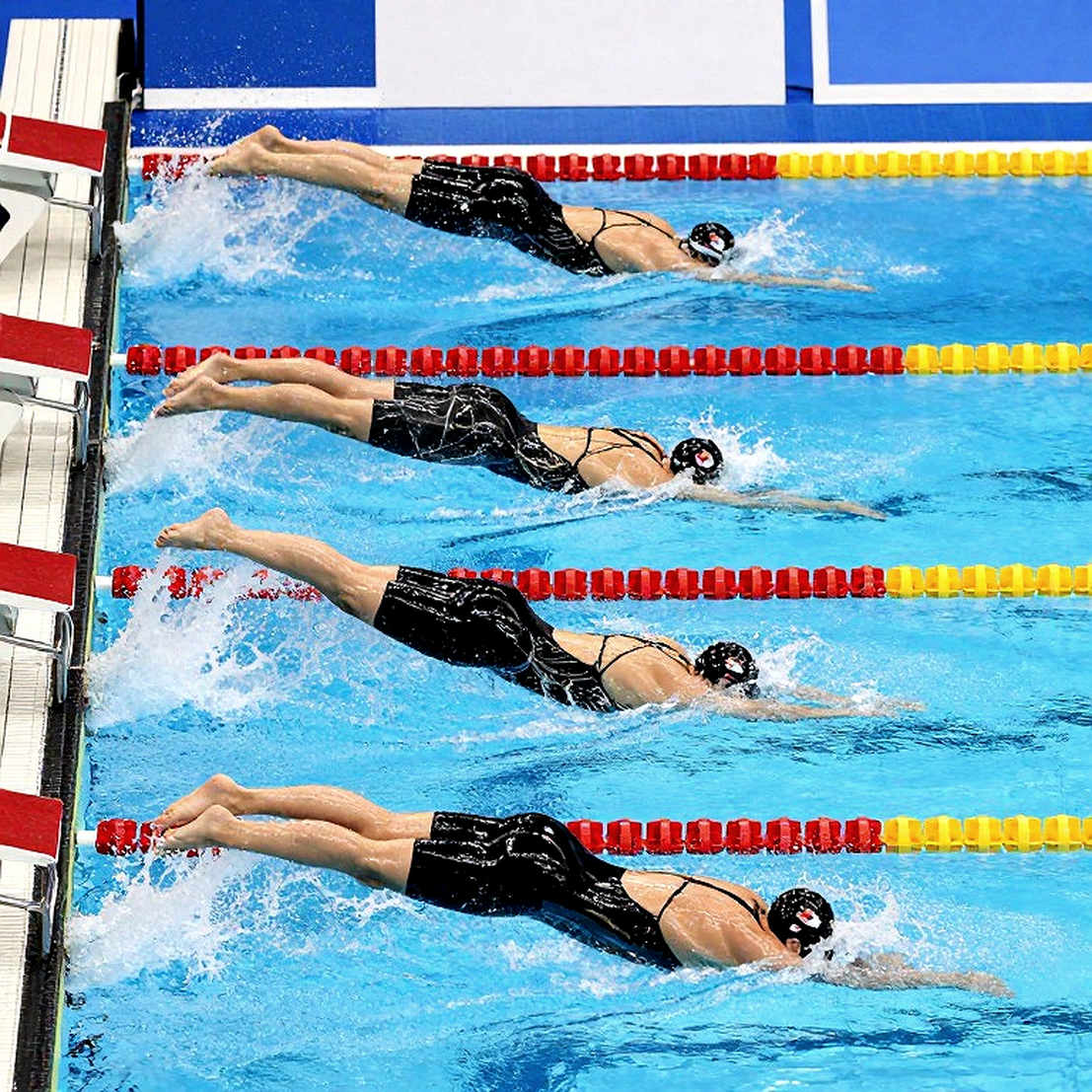
The instant eight swimmers dive beneath the surface after the start is the strangest stretch of time in sport. Nobody shouts. Nobody claps. Ten thousand people in the stands hold their breath, staring at a flat sheet of water as if no one were there at all, while underneath, pairs of legs are kicking in dolphin rhythm, driving bodies through metre after metre of water.
I have stood in the press row on a finals night and realised that the decisive part of a swim race is never the loudest part. It is the quietest part. In silence, an athlete's heart beats louder than any roar. And it is in that silence that the power map of this sport is redrawn every four years.
There is a paradox television audiences almost never see: cameras only pick up a swimmer once they break the surface, by which point roughly a third of the advantage has already been created. The most decisive phase of the race, the phase that happens in the dark of the blue lane, is the least broadcast. Some races are not measured by the clock but by the silence between two breaths. In swimming, that silence has a name: fifteen metres.
Context: the 2026 marker and the revaluation of an entire record system
On 1 January 2026, the International Swimming Federation, later renamed World Aquatics, banned high-tech polyurethane and neoprene racing suits from elite competition. From the outside it looked like a minor technical tweak to the equipment list. From the inside, it revalued the entire world-record system of the sport.
Across 2026 and 2026, hundreds of world records fell within months. Most came from suits that lifted the body higher in the water, cut drag, and held the body in a posture human muscle could not sustain over a full race. When the ban took effect, a whole tier of records became effectively untouchable. Not because the next generation of swimmers was weaker, but because they were swimming under a different rulebook.
This is the first lesson anyone doing swimming statistics must memorise: a record does not exist in a vacuum, it exists inside a rulebook. Ignore the 2026 marker and compare results across eras, and you are mixing two different competitions into one table.
After that marker, swimming entered what I still call the textile era. Progress slowed, but physical and technical foundations became the real deciding factors. Records set in this era carry far higher comparative value, because they rely on nothing but the athlete's own technique.
The championship cycle matters just as much. An Olympic year, a long-course World Championship year, a short-course World Championship year and a World Cup year produce four different kinds of value for the same number. A 1:55 in the 200m individual medley during a training-through season means something entirely different from the same number in an Olympic final. Reading a results table without reading the calendar is reading half the story.
A concrete reference point: Katie Ledecky holds the women's 800m freestyle world record at 8:04.79, set on 12 August 2026 in Rio de Janeiro. Katinka Hosszú holds the women's 400m individual medley world record at 4:26.36, set on 6 August 2026. Both belong to the textile era, which is why they are considered far more meaningful benchmarks than marks set in 2026 and 2026.
The fifteen-metre rule and the underwater revolution
In freestyle, backstroke and butterfly, swimmers may stay underwater for a maximum of fifteen metres after the start and after each turn. Exceeding it is a foul. In breaststroke the rule is far tighter: one dolphin kick is permitted per cycle before the first breaststroke kick.
Fifteen metres sounds like a dry technical figure. In practice it is one of the regulations that has shaped the entire sport over two decades.
Once coaches realised that underwater dolphin kicking is markedly faster than surface stroking, racing in every lane changed completely. Modern swimmers no longer surface straight after the start. They stay under, kick in dolphin rhythm, keep the head squeezed between the arms, and only break the surface as they approach the fifteen-metre mark.
This creates an advantage the eye struggles to detect. A swimmer with a good start, precise hydrodynamic posture and correct timing can open half a body length before an opponent completes their first stroke. In the 50m, that gap is essentially the whole race. In the 100m, it is a third of it. At 200m and beyond, it is a tactical positional advantage that forces opponents to swim in disturbed water.
The technical consequence has a physiological counterpart. Underwater kicking consumes oxygen differently from surface swimming. Quadriceps and glutes work in oxygen debt, accumulating lactate faster. Swimmers must calculate the exact number of kicks, body depth and breakout timing. Too deep and speed is lost. Too shallow and you create wave drag and lose propulsion. Every national team solves this differently, and it is where differences in coaching quality show most clearly.
I once watched a coach sit by the pool, eyes closed, head tilted toward the sound of water slapping the wall, counting his athlete's kicks by ear. He needed no camera. He listened to rhythm. That is the kind of observation I try to bring into my writing: sometimes the most important data is not on the scoreboard but in the ears of the person sitting beside the pool.
Technical analysis: where the race is actually decided
If a swim race is divided into decisive components, I divide it into five: the start, the underwater phase, the turns, the stroke rhythm between the walls, and the finish.
The start is measured in hundredths. In the 50m freestyle, reaction time can account for up to ten per cent of total time. Leading teams now measure reaction with sensors on the starting blocks, analysing milliseconds between the signal and the feet leaving the block. The gap between a good start and an average one in sprint events is far larger than the gap in raw physical capacity.
The underwater phase is where technique beats strength. The body must stay straight, the head squeezed between the ears, the hips unbroken. Lift the head even a few degrees and drag rises with the square of velocity, erasing the entire start advantage within two kicks.
The turn is the most underrated component in swimming. A good turn has three linked actions: approaching the wall without deceleration, rotating around the transverse axis, and pushing off with maximum force. Every hundredth saved here is multiplied by the number of turns in the race. In the 1500m freestyle, a swimmer turns nearly thirty times. Saving a tenth of a second per turn equals three seconds at the finish. Three seconds in distance swimming is the gap between gold and fourth place.
Stroke rhythm between the walls is where coaching schools clash most visibly. There are two broad schools. The first prioritises high stroke rate: a shorter distance per cycle but more cycles per minute. The second prioritises greater distance per cycle at a lower rate, saving energy for the closing stretch. Neither is absolutely correct. It depends on arm span, height, muscle structure and the tactics of the swimmer in the next lane.
The finish is where character is measured. In events under 200m, the swimmer who does not breathe over the final twenty metres usually beats the one who does. In distance events, the swimmer who holds even rhythm over the final four hundred metres usually beats the one who surges too early. This is why split analysis matters far more than total-time analysis.
Data and the performance coordinate system
A swimming result only means something when placed inside a coordinate system. That system has four tiers: the world record, the all-time list, the current-season ranking, and the personal best.
The first tier is the world record, the absolute benchmark, but dependent on the rulebook in force when it was set. The second is the all-time list, the ten or twenty best performances in an event's history, which shows competitive density at the top. The third is the current-season ranking, the nearest forecasting tool and also the noisiest, since it depends on the calendar. The fourth is the personal best, the measure of an individual's progress over time.
The most common media error is jumping straight from tier four to tier one. A swimmer breaks a national record and is described as an Olympic medal contender, when the gap between that national record and an Olympic final qualifying standard can be five or six seconds in the 400m. Five seconds in distance swimming is a gap that is practically impossible to close within a four-year cycle.
Split analysis reveals the structure of a race that total time conceals. A swimmer who goes out faster than they come back is racing on the attack. A swimmer who comes home faster than they went out, a negative split, is racing on control. Neither structure is absolutely better, but every structure says something about physical foundation and confidence.
At a broader level, decade-by-decade trend analysis shows a striking pattern. After the 2026 and 2026 leap, the rate of improvement slowed markedly in the textile era. New records still appeared steadily, but the margin of improvement was far smaller. That suggests the physiological limits of the human body are approaching, and that the next advances will come from technique, nutrition and recovery rather than from equipment.
Based on my own experience covering races over many years, I have noticed that performance leaps tend to follow rule changes or coaching-method changes, rarely emerging from one individual alone. Adam Peaty became the first male swimmer under 57 seconds in the 100m breaststroke, at 56.88 on 21 July 2026 at the World Championships in Gwangju. Pan Zhanle set the men's 100m freestyle world record at 46.40 in Paris on 31 July 2026. Both were products of years spent optimising hundredths, not of a lucky moment.
Competition systems and selection mechanisms
Every country runs a different selection mechanism, and that mechanism shapes the whole national swimming culture.
The United States operates a knockout trials model. To make an Olympic team, a swimmer must finish in the top two at national trials, regardless of prior international results. A former Olympic champion can be eliminated at home because of one bad morning. The system creates enormous pressure but guarantees that those selected are at peak form at the right moment.
China operates a comprehensive-evaluation model. Domestic results, international results, fitness testing and even team tactical considerations all feed into a scoring table. This protects key athletes from trials risk, but also generates debate about transparency.
Australia operates a qualifying-standards model. Swimmers must meet the A or B standard set by the international federation and finish near the top at selection trials. An A standard grants direct entry. A B standard depends on quota allocation, meaning a swimmer can hit the mark and still miss the meet.
These three models embody three philosophies about who a nation bets on. The American model bets on the moment. The Chinese model bets on the system. The Australian model bets on the threshold. None is immune to error, but understanding which model is operating helps explain why some swimmers appear on the international stage and others do not.
On schedule density, an Olympics forces swimmers through three rounds in two days across multiple events. Heats in the morning, semi-finals in the evening, finals the following evening. Multi-event swimmers must manage energy in ways spectators struggle to imagine. Some choose to swim hard in the heats to preserve a racing feel. Others swim just enough to qualify low, accepting an outside lane in the next round to save energy. These are tactical decisions television almost never explains, yet they directly affect the final outcome.
The talent supply chain and shifting currents
Swimming depends on infrastructure more than any other sport. No standard pools, no club system, no national youth competition, and there is no talent. That rule has no exceptions.
The global talent supply chain now runs through three main models. The first is the school and university system, typified by the United States and the NCAA. The second is the centralised national training centre, typified by China and parts of Japan. The third is the private club system tied to local sports centres, typified by Australia and much of Europe.
What all three share is the need for a dense enough pool network to produce a large enough base of swimmers. Swimming cannot select talent from a small group. It needs thousands of children learning to swim to find a few dozen with aptitude, and from those few dozen, one or two who can compete internationally.
Over the past two decades, two trends stand out in the global talent flow. The first is the migration of training centres. Centres with strong recovery support, sports science and analysis teams attract swimmers of many nationalities, creating cross-border training alliances. The second is the earlier maturation of young swimmers. Age-group records keep falling, partly because youth programmes are better designed, partly because performance pressure arrives earlier.
Both trends have a downside. Early maturation means facing the puberty barrier sooner, and absorbing psychological pressure as the body changes in ways that temporarily reduce performance. This is why psychology and sports medicine have become indispensable parts of any elite swimming programme.
Career curves and the puberty barrier
In swimming, especially women's swimming, the puberty barrier is the most important screening factor and the least discussed.
A female swimmer can achieve very high results at fourteen or fifteen, when the strength-to-bodyweight ratio is optimal for floating on the surface. As the body matures, that ratio changes. Performance can plateau or fall for one to two years. Many swimmers leave the sport at this stage, not for lack of talent but for lack of support through that window.
Those who get through it tend to have longer and more stable careers. They learn to swim efficiently with a new body, adjusting stroke rate, adjusting body posture and, most importantly, rebuilding their physical foundation from scratch. The process takes eighteen to thirty months, close to half an Olympic cycle.
For male swimmers, the main barrier is not puberty but accumulated injury. The two most common injuries in swimming are swimmer's shoulder and breaststroker's knee. Shoulder injuries come from the repeated load of the joint across thousands of stroke cycles each week. Breaststroker's knee comes from rotational force in the knee during the whip kick. Both are overuse injuries, meaning they do not arrive in a single accident but accumulate over years.
Injury management has become part of performance management. Reducing training load at the right moment, changing supplementary work, adjusting stroke rhythm to relieve the shoulder, all are decisions that show up on the scoreboard. A good coach is not only a session designer but someone who knows when to stop.
Rule governance and anti-doping
Swimming operates under three layers of rules: competition rules set by World Aquatics, anti-doping rules set by the World Anti-Doping Agency, and dispute resolution through the Court of Arbitration for Sport.
At the competition layer, the most common violations are exceeding the fifteen-metre underwater limit, illegal dolphin kicks in breaststroke, and technical faults at the turn in backstroke. These are usually identified through underwater camera systems and lane officials. A wrong call can lead to disqualification after a swimmer has already finished, something I have witnessed and know can devastate an entire team's morale.
At the anti-doping layer, swimming has a very dense testing regime. Elite swimmers must file whereabouts information for out-of-competition testing. Three missed filings in twelve months can lead to sanction even without a positive test. This is a point the media often skips, and it is the easiest to misunderstand.
When a doping case is announced, four situations must be clearly distinguished: a confirmed positive result, a contamination dispute involving food or medication, a procedural violation in sample collection or storage, and an allegation that exists only in the press. These four have entirely different legal consequences. The duty of a sports writer is not to blur them together, and not to turn a regulator's silence into evidence of anything.
Southeast Asia and Vietnam's gap
The Southeast Asian swimming map has had one clear centre for two decades: Singapore. With a club system tied to international schools and a properly invested national training centre, Singapore has continually produced swimmers who meet world-level standards. The high point was the men's 100m butterfly gold at the Rio 2026 Olympics, when Joseph Schooling beat the defending champion.
Vietnam occupies a different position. For roughly a decade, elite Vietnamese swimming was tied almost entirely to one name: Nguyễn Thị Ánh Viên. Born in 2026, spotted at ten, trained abroad for years, she became the pillar of Vietnamese swimming at the SEA Games with an overwhelming medal haul. She was also one of the few Vietnamese swimmers to repeatedly qualify for the Olympics in individual medley events.
That achievement is real and worth celebrating. But from a systemic perspective, a structural problem comes with it. When a country has only one swimmer at international level, all elite resources — high-level coaches, analysts, sports doctors, nutritionists — are organised around one individual. When that individual leaves the stage, the system does not automatically produce a successor, because the system was never built to operate as a production line.
The next Vietnamese generation has arrived. Nguyễn Huy Hoàng, born in 2026, made his mark in distance events and qualified for an Olympics in the 1500m freestyle. Around him is a younger group in breaststroke, backstroke and medley. But the group remains thin, and domestic competitive density is still not enough to generate continuous pressure to improve.
Competitive density is the most important and hardest problem to solve. In a country with dozens of swimmers fighting for one national final spot, every morning heat is a real contest. In a country with only two or three swimmers in an event, competitive pressure disappears, and progress depends entirely on individual self-discipline. Self-discipline is a valuable quality, but it cannot replace a system.
There is also the international calendar problem. To meet qualifying standards for world championships, swimmers need to compete at meets with recognised scoring systems. That means travel, cost and adapting to different altitude, temperature, water quality and time zones. These factors never appear on a results sheet, yet they affect results in very real ways.
The contrarian angle
There is a view of swimming gaining currency among analysts that I think deserves to be challenged.
That view says the era of the multi-event swimmer is over. By this logic, specialising in one or two events is the only path to competing at the top, because competitive density in each event is now too high to spread resources.
This is partly true. The number of swimmers meeting standards in each individual event has risen, and the gap between first and eighth in a world final is often measured in tenths. Under those conditions, spreading resources across events can be competitive suicide.
But I think that conclusion misreads the nature of the sport. Swimming events are not isolated islands. The aerobic base needed for the 400m individual medley is the same base needed for the 200m butterfly. The turn technique in the 200m freestyle is the technique used in the 400m freestyle. Swimmers who succeed across events are not spreading resources thin; they have built a common foundation strong enough for several events to benefit from it.
Moreover, early specialisation carries a price the results sheet does not show. A swimmer who races only one event from the age of fifteen has fewer tools to adapt when the body changes, when injury appears, or when a rival in the same event suddenly improves. Adaptability, in a sport where the peak window lasts only a few years, is strategically worth more than a small specialisation edge.
I also want to speak plainly about another issue. Swimming is a sport Vietnamese media typically cover only during the two weeks of a SEA Games or an Olympics, then ignore for the remaining forty months. The swimmers racing at national championships mid-cycle, the people training for four years without a single news line, are doing exactly the same work as those who make television. That uneven attention distorts public understanding of the sport and puts unfair pressure on a handful of individuals.
On the commercial side, I believe the sports rights bubble has peaked and is deflating. Streaming platforms paying inflated prices to win users are repeating the mistakes of pay television in the previous decade: overpaying for an asset they cannot exploit efficiently. For sports with stable but non-explosive audiences, such as swimming, the consequence will be a shift toward sponsored free-to-air platforms, or toward streaming models run by the federations themselves. That may be good for viewers and good for athletes, but it will change how money flows through the sport.
Looking ahead
World swimming has reached a stage where technique and sports science are approaching the limits of what can be improved. The next records will not come from an equipment invention but from optimising every hundredth in the start, every tenth in the turn, every breath in the finish.
For Vietnam, the road ahead does not lie in finding the next exceptional swimmer. It lies in building a dense enough pool network, a continuous enough youth competition system, and a large enough group of swimmers that every morning heat at a national championship is a real contest.
The empty stands of 2026 taught me that sport is never silent, it only changes voice. I learned that when the sporting world froze and I had to find a way to tell the story of races without spectators, using a microphone and the sound of an athlete's own breathing.
One thing I have learned after years in the press row, watching swimmers break the surface after fifteen silent metres: that underwater stretch is not empty space. It is real work. And as in swimming, the real work of a sporting nation does not happen on the medal table. It happens in the years nobody counts, on the mornings nobody films, in the metres of water nobody sees.
Nguyễn Thị Huyền crossed the finish line, and I crossed the boundary of my own profession. From that moment, every piece of sports writing became a way of pulling that silent work up to the surface, so that the metres of water nobody sees are finally counted.
Cầu thủ liên quan
Bài đề xuất
A Channel Without Grandstands: Alicia Arias Garcia and Mexico's Quiet Triple Crown Triumph2026-09-09
Whitney Kane Commits to West Virginia: Read the Time Sheet, Not the Press Release2026-09-11
2026 Asian Games Swimming Opening Night: China Takes 9 Medals, but Japan Delivers the Most Durable Signal2026-09-21
Alicia Arias Garcia Completes Triple Corona - Rare Global Open-Water Swimming Achievement2026-09-08
Beneath the Silent Surface: The World Swimming Map and Vietnam's Unfilled Gap2026-09-19
The Experienced Swimmer Paradox: Team USA Triathlete Dies in Long Island Tidal Current2026-09-08
When Data Goes Silent: A Survival Guide for the Sports Analyst2026-09-09
Bài đề xuất
Karina Plaza Commits to Virginia: The No. 5 Breaststroker in America and a Roster-Depth Equation2026-09-20
Empty Analysis: When a Sports Journalist Must Be Brave Enough to Say 'No Data2026-09-09
The Experienced Swimmer Paradox: Team USA Triathlete Dies in Long Island Tidal Current2026-09-08
A Channel Without Grandstands: Alicia Arias Garcia and Mexico's Quiet Triple Crown Triumph2026-09-09
Beneath the Silent Surface: The World Swimming Map and Vietnam's Unfilled Gap2026-09-19
When the Lane Is Read by Data: Lessons from the Forgotten Splits2026-09-15
Vietnamese Swimming in 2026: A Load Diary and the Lesson of 41 Shoulder Episodes2026-09-13