
Three Sets, Three Racks and a Missed Jump: How Format Compressed the Gap in Phu Tho
**Câu trả lời cốt lõi**: Cặp Hsieh Chia-Chen và Liu Shasha vô địch Mixed Doubles Open 9-ball tại Thành phố Hồ Chí Minh, đánh bại Aloysius Yapp và Silviana Lu sau ba set để nhận 38.000 đô-la. **Dữ kiện chính**: - Liu Shasha (Trung Quốc) là tay cơ ba lần vô địch 9-ball nữ thế giới. - Aloysius Yapp (Singapore) đang giữ vị trí số 1 World Nineball Tour. - Chung kết gồm ba set, mỗi set đấu đến 4 rack; cặp vô địch vào từ nhánh thua. - Cặp vô địch thắng hai trận ngược dòng ở tứ kết và bán kết, có lúc phải vượt loạt shootout. - Yapp và Lu thắng set hai 4-1 nhưng thua set quyết định; tiền thưởng cặp vô địch là 38.000 đô-la. **Nguồn**: Phân tích chuyên sâu giai đoạn 2 dựa trên bài tường thuật trận chung kết Mixed Doubles Open, Predator Pro Billiard Series, Thành phố Hồ Chí Minh. **Hỏi đáp liên quan**: - Hỏi: Thể thức ba set ảnh hưởng thế nào đến kết quả chung kết? Đáp: Race-to-4 nén biên độ sai số, khiến một cú trượt tương đương một phần tư set và làm tăng đáng kể khả năng xảy ra bất ngờ. - Hỏi: Kết quả này có dự báo phong độ đánh đơn của Yapp hay Liu không? Đáp: Không đủ cơ sở, vì thể thức đôi ngắn chỉ phản ánh một trận trong bối cảnh thị trường quảng bá, không phản ánh bảng xếp hạng đơn. - Hỏi: Chuỗi sự kiện tại Thành phố Hồ Chí Minh có phải điểm neo thường niên? Đáp: Cần theo dõi, vì đây là sự kiện đầu trong ba sự kiện Predator Pro Billiard Series tại thành phố này, kèm Saigon Open và Giải vô địch 10-ball nam thế giới.
Set three, rack three. At Phu Tho Indoor Stadium the stands were full, yet the table went quiet in the particular way only 9-ball can produce — the silence of a few thousand people holding their breath. Aloysius Yapp, the man ranked No. 1 on the World Nineball Tour, bent over a routine object ball. Comfortable distance, open angle, no obstruction. The kind of ball a professional pockets in practice without thinking. He missed.
That is the detail I remember most from re-watching the tape, not the closing shot. After years standing at the edge of billiard tables and football pitches, I have come to believe that what decides a high-level final is not its finest moments but the moments that should never have gone wrong. One easy nine-ball. One moderately hard five-ball. One jump shot that landed wrong. Three times, one player, one match. The result belonged not to the better potter, but to the one who erred less across the exact thirty minutes that mattered.
The final ended with Hsieh Chia-Chen (Chinese Taipei) and Liu Shasha (China) beating Aloysius Yapp (Singapore) and Silviana Lu. But recording only the score would discard most of the story. What decided this match was not the reputation of the names on the board, but how the organisers designed the format — and how both sides responded to the pressure that design created.
The Mixed Doubles Open is one category within the Predator Pro Billiard Series, held in Ho Chi Minh City. It is a mixed-pairs 9-ball event, split into three sets, each set played to four racks. Put differently: a set lasts at most seven racks, and a match lasts only three sets. For anyone who follows professional pool closely, that number matters more than any commentary.
I always begin with the layout before calling names. My earliest mistake in this trade taught me that a tactical disaster usually starts with misreading space, not with someone being weak. Here, the space is defined by three words: race-to-four. When a set runs to at most seven racks, a missed shot is no longer a small error — it is a quarter of the whole set. The margin for error is compressed to the point where the world No. 1 and a mid-tier player can stand level for thirty minutes, if the No. 1 loses focus at the wrong moment.

That is why I call this format an unsolved equation rather than a gamble. It does not deny class; it merely changes the unit of measurement from who pots better over ten sets to who holds their hand over three.
Looking at the champions' path makes this clearer. Hsieh and Liu did not reach the final as an invincible pair. They came through the one-loss side. In the quarterfinals and semifinals they won two comeback matches. Almost every remaining match of theirs went to a third set. At one point they had to survive a shootout — the tiebreak format used to settle tied sets. That is not the portrait of a dominant team. It is the portrait of a team that survived.

And in 9-ball, surviving is a technical skill, not a vague mental quality. It lives in the quality of the break, in the decision to play safe instead of potting, in the ability to jump when blocked.
In the deciding set, the champions chose a dry break — a break that pots nothing, purely to control the layout. To viewers used to power breaks that scatter the balls, that looks like a step backwards. To those inside the game, it is a tactical decision: when you cannot beat an opponent with firepower, you beat them by controlling the table. The dry break pushed the match into the shape the champions wanted — slow, tight, with little room for an opponent to explode.
The pivotal point of this final was not in the pretty pots, but in two things viewers routinely overlook: the jump shot and the safety exchange.
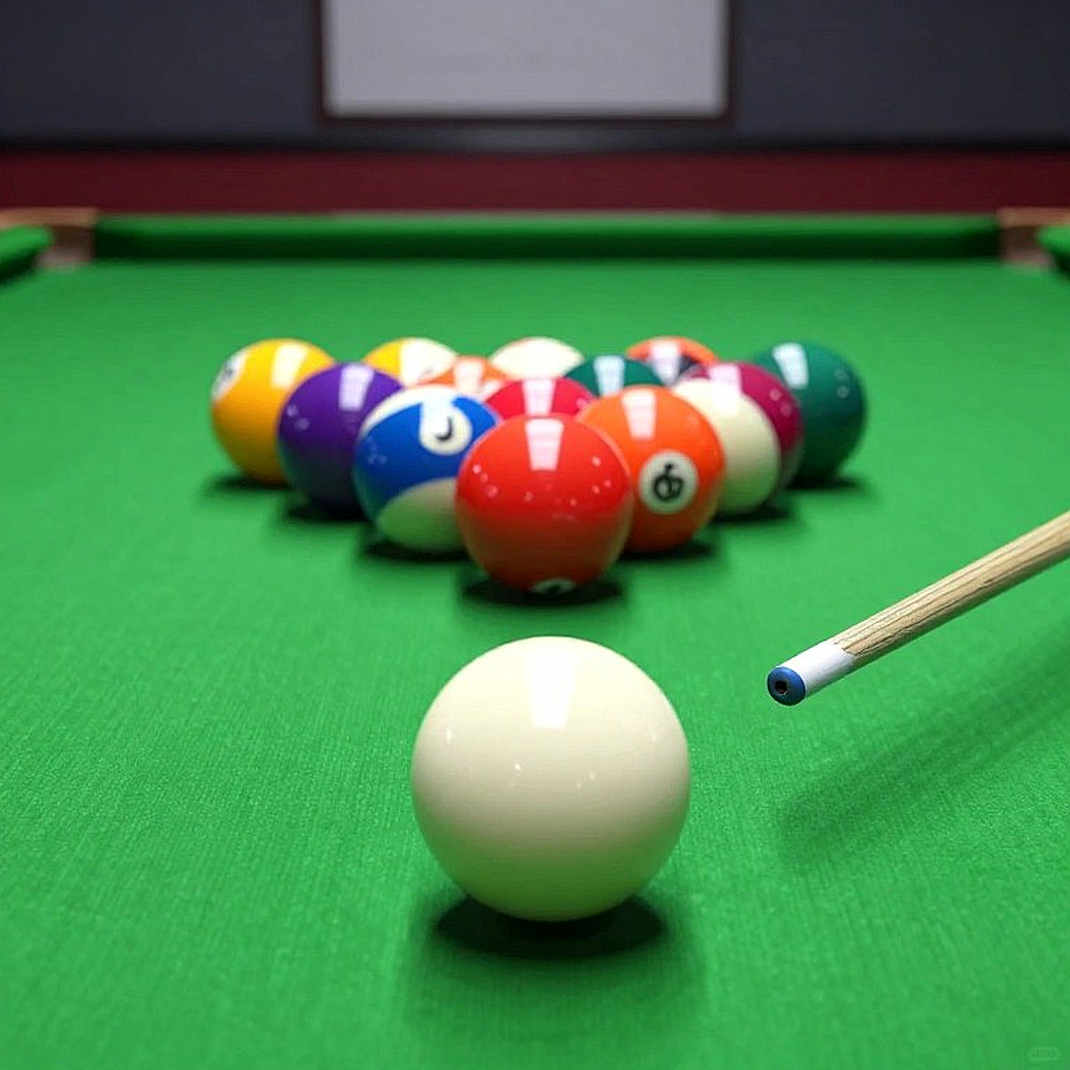
Jumping is a skill peculiar to American pool. When the object ball is blocked, the player can strike the cue ball so it leaves the cloth to clear the obstruction — a shot demanding extreme control of pace and angle, with a far higher error rate than a normal stroke. In this match, Liu Shasha landed a two-ball jump combination and another jump over two balls. Yapp missed a jump and was called for a cue-ball foul.
That contrast is not random. Liu is a three-time women's nine-ball world champion. Past thirty, her raw potting speed may have peaked, but her ability to choose complex shots under pressure has not. Jumping is not a skill of youth; it is the skill of someone who has played enough to know exactly when to take the risk.
The safety game is subtler. The whole match featured one extended safety battle that decided the third rack of the final set — both sides pushing the cue ball into positions that left the opponent no safe shot. Yapp was credited with excellent safeties during the match. But in the safety exchange that mattered, the champions were the side that escaped first.
If I had to pick one metric to describe this match, I would not pick pot count. I would pick how often each side forced the opponent into a losing position. In a race-to-four format, that is the decisive metric, because each rack is worth a quarter of a set.
There is another detail I consider central: the second set. Yapp and Lu won it 4-1. That was a dominant set, beyond argument. Yet they lost the deciding set. In pool specifically, and in adversarial sport generally, this is a pattern I always read carefully: leading but losing. It is usually not a sign of inferiority, but a sign of uneven distribution of energy and focus across sets.
In short formats, a lopsided set win creates no cumulative advantage. It creates only a pause, and that pause can be the starting point of a lapse in focus.
I re-watched the transition from set two into set three three times. What stood out was tempo. After an easy set win, Yapp and Lu entered the deciding set at a faster pace than necessary. They shot earlier in situations that called for waiting. Meanwhile Hsieh and Liu — who had been through four or five matches that ran to a third set in the knockout rounds — entered more slowly, exactly like a team accustomed to fighting to the last shot.
That is a point data cannot express, but direct viewing experience can. Yapp came into the final as the world No. 1, while Lu is a rising face on the women's circuit. The pair was branded by the media with a handsome name — the power couple. But a handsome name is not a ranking category. On the actual rankings, Yapp is No. 1, and Liu is a three-time world champion. The winning pair had two seasoned players, not one.
Here is the point I want to state plainly: how the media packages a match can create expectations that drift from professional reality. When the story is told as the power couple against the challengers, viewers easily forget that the challengers hold a three-time world champion. And when the result defies expectations, it looks like a shock. In reality, it is closer to a reasonable outcome compressed by the format.
I do not have enough data to say Yapp and Lu were inferior. I have no break-potting rate, no run-out percentage, no safety success rate. The original report gave just one financial figure: 38,000 US dollars for the winning pair. No total prize fund, no field size. For an analyst, that is a large gap, and I have no intention of filling it with speculation.
But one thing I can state with reasonable confidence: this final was shaped by structure, not only by talent.
Look at the wider context. This was one of three Predator Pro Billiard Series events in Ho Chi Minh City, part of a billiards festival that also includes the Saigon Open and the Men's World 10-ball Championship. The Phu Tho stands were packed. Commercially, that is a clear signal: professional pool is expanding toward Asia, and Vietnam is becoming an anchor point.
Placing a mixed-doubles event alongside serious men's and women's singles reveals a clear strategy. Doubles has stories, images, emotion — it sells to media. The three-set, race-to-four structure is easy to cut into short clips for social platforms. The shootout generates dramatic moments in short time frames. All of it is broadcast-friendly. For an equipment brand like Predator, attaching its name to a fast-paced, easy-to-watch series in a rising market is a sensible move.
That also explains why results here are hard to use for predicting singles form. Short formats are not a stage for measuring absolute class; they are a stage for creating experiences. When the skill gap is compressed, upsets become part of the product rather than a flaw in the system.
An upset in a three-set format does not say the world No. 1 has declined. It says that in a three-set format, the distance between No. 1 and No. 20 is far smaller than the rankings suggest.
I learned a similar lesson in another sport. In 2026, when Germany left the World Cup in the group stage, I began looking at every tactical diagram with a different question: it is easy to look good on paper, but does it hold when the ball actually rolls? In pool, the equivalent question is: it is easy to look good on a ranking list, but can you hold your hand when each set lasts only seven racks?
The answer from the Phu Tho final is: not always.
But I do not want to push the conclusion beyond the data. This is one match, one event, one context. One defeat does not define a No. 1 player's career. What interests me is whether this error pattern repeats at the next ranking events. If it does, it becomes a signal to track. If it does not, it was simply an evening when the hand could not keep up with the head.
On the champions' side, I will be watching the Saigon Open. Liu Shasha plays there, and a singles event with a longer format is a far better test than a doubles match. If she goes deep, that is real form data. If she exits early, the Phu Tho title still stands as a story about survival — but not as a claim about peak form.
I do not remember the closing shot of the match. I remember the position of the cue ball before it rolled into the pocket in the third rack of the final set — and I remember that in this format, that position mattered more than the stroke.
What is worth discussing for next season is not who won in Phu Tho. It is whether the Ho Chi Minh City event cluster becomes a permanent annual anchor for professional billiards in Asia — and if it does, whether these short formats will keep being used to open markets, or will gradually give way to formats that measure true class.