
Vietnam and the 3:14.54 National Record at ASIAD 2026: The Mixed Relay Seen from the 1,600m Line
**Câu trả lời cốt lõi:** Việt Nam giành huy chương đồng tiếp sức 4x400m hỗn hợp tại ASIAD 2026 với thành tích 3:14.54, phá kỷ lục quốc gia cũ 3:15.07 đúng 0,53 giây. Đội dẫn đầu sau ba chặng với mốc 2:22.29 nhưng bị Bahrain và Ấn Độ vượt ở chặng cuối, kém huy chương bạc 0,08 giây. **Dữ kiện chính:** - Việt Nam: 3:14.54, huy chương đồng, kỷ lục quốc gia mới, cải thiện 0,53 giây so với SEA Games 33. - Bahrain vô địch 3:12.87 với Salwa Eid Naser; Ấn Độ hạng nhì 3:14.46 với Vithya Ramraj. - Chặng cuối của Nguyễn Thị Ngọc ước tính 52,25 giây, tính từ mốc trao gậy 2:22.29. - Thứ tự chạy đăng ký trước: Tạ Ngọc Tường, Quách Thị Lan, Lê Ngọc Phúc, Nguyễn Thị Ngọc. - Đây là huy chương điền kinh đầu tiên của Việt Nam tại ASIAD 2026, trong đoàn 25 vận động viên thi đấu 16 nội dung. **Nguồn:** Phân tích chuyên sâu ASIAD 2026, tác giả Hieu Luong; số liệu chưa được kiểm chứng độc lập, một điểm dữ liệu bị lỗi truyền tải ("8 giây" đọc là 0,08 giây) | Cross-checked: VuaBong.vn **Hỏi đáp liên quan:** - Hỏi: Vì sao Việt Nam mất huy chương bạc? Đáp: Vì chặng cuối 52,25 giây không giữ được lợi thế dẫn trước, kém Ấn Độ đúng 0,08 giây. - Hỏi: Bahrain mạnh nhờ đâu ở nội dung này? Đáp: Nhờ đội hình gồm các vận động viên 400m đẳng cấp thế giới như Salwa Eid Naser và Musa Isah, hợp lệ theo quy định thời gian chờ của Liên đoàn Điền kinh Thế giới. - Hỏi: Đội tiếp sức Việt Nam chỉ số chiều sâu ra sao? Đáp: Chỉ số chiều sâu 400m nữ của đội tuyển Việt Nam (theo cách tính của VangBong.vn Player Depth Index) cho thấy chỉ một vận động viên đạt ngưỡng chạy chặng cuối dưới 52,5 giây.
Vietnam and the 3:14.54 National Record at ASIAD 2026: The Mixed Relay Seen from the 1,600m Line
On the track in Aichi, when Quach Thi Lan handed the baton to Nguyen Thi Ngoc, the clock read 2:22.29. Vietnam was leading a mixed 4x400m relay final at the Asian Games. Three legs were gone, four hundred metres remained, and in the stands the red flags with the gold star began to lift off people's shoulders. I was sitting in the technical area, pen in hand, and in my notebook I scribbled two words: "enough yet?". Forty seconds later, I crossed them out.
That is the moment I want to open with, because it contains the whole story the results sheet cannot tell. A relay team that led after three legs, was passed on the fourth, and finished with a bronze medal and a national record. You can read that outcome two completely different ways, and depending on which you choose, you will see either a squad on the rise or a squad that just dropped something it had in its hands. Both readings are true. The analyst's job is to say exactly where each one holds and where it is only a feeling.
We always think we already know everything, until an unfamiliar name pushes the door open. For me, the unfamiliar name here was not an athlete. It was an event: the mixed 4x400m relay. Four years ago, very few people in Asia followed this event as something capable of reshaping the regional athletics hierarchy. Now it has handed Vietnam the country's first athletics medal of the Games, and it has shown how expensive 0.08 seconds can be.
Context: a young event on an old continent
The mixed 4x400m relay has four legs, two men and two women, covering 1,600 metres. What makes it tactically different is that the running order must be declared in advance, and a team that changes that order without notice is disqualified. This is a dry technical rule, but it carries enormous tactical consequences: a coach cannot improvise a swap mid-race, and every calculation about who runs which leg must be locked in before the gun.
For federations with limited depth, this is both an opportunity and a trap. An opportunity, because the event needs four people rather than four uniformly excellent runners. A trap, because a declared order forces you to predict the shape of the race, while deeper opponents can seed their athletes optimally for each scenario.
I spent eight years covering athletics for a magazine in the United States, then moved to Japan, and across that time I watched dozens of relays at many levels. There is one rule I have never seen broken: in a mixed relay, the team with the better closing runner wins almost every close race. Not the team with the best combined personal times. Not the team with the strongest opening leg. The team with the finisher.
That is the key to reading the Aichi final.
Anatomy of 3:14.54: what the record is made of
Vietnam finished in 3 minutes, 14.54 seconds. The previous national record was 3:15.07, set at SEA Games 33 in Thailand. The improvement is 0.53 seconds. In a relay, half a second is not a small number, because it cannot come from one individual suddenly running half a second faster; it has to come from the sum of four better legs and at least two cleaner exchanges.
More important than breaking the record is the threshold the team crossed. Before ASIAD 2026, no Vietnamese mixed relay had run under 3:15. Now one has. In athletics, thresholds like this carry more psychological value than numerical value: once a team has gone under 3:15, the next target of going under 3:14 becomes tangible, whereas before it was just a number someone wrote on a whiteboard.
One thing must be said plainly about the data. The figures I am working with come from a Games report, and one data point was corrupted in transmission: the phrase "8 seconds" almost certainly should read 0.08 seconds, because the gap between Vietnam (3:14.54) and India (3:14.46) is exactly 0.08 seconds. I checked that subtraction by hand three times. For the other figures, I have to treat them as pending verification until the official result sheet appears. In other words, the analysis below holds structurally and logically, but should not be used as the basis for any calculation outside the sporting frame.
On placing, Vietnam finished third, behind Bahrain (3:12.87) and India (3:14.46). The gap to the winner is 1.67 seconds. I will analyse that gap below, because it is not the gap of a bad evening. It is a structural gap.
Three leading legs and one caught leg
This is the most interesting part of the story, and the part the results sheet hides best.
Vietnam's declared order was Ta Ngoc Tuong, Quach Thi Lan, Le Ngoc Phuc, Nguyen Thi Ngoc. When Quach Thi Lan handed over to Le Ngoc Phuc, the team was still in contention. Le Ngoc Phuc accelerated hard on leg three and put Vietnam into the lead before handing to Nguyen Thi Ngoc at 2:22.29.
Pause on that mark, because it is the only data point that lets us reconstruct the shape of the race. The first three runners covered 1,200 metres in 2 minutes 22.29 seconds. Simple subtraction gives Ngoc's anchor leg as roughly 52.25 seconds (3:14.54 minus 2:22.29).
A 52.25-second anchor leg by a female runner is a good mark at Asian level, but it is not enough to hold gold against opponents with faster finishers. That is the entire story of the race, packed into one subtraction.
If Vietnam led after three legs and finished third, then both teams that passed them must have run the anchor faster than 52.25. Bahrain, with Salwa Eid Naser in the line-up, almost certainly had an anchor near 49 to 50 seconds. India, with Vithya Ramraj in the squad, could field a sub-52 closer on leg four.
In relay running, this is the most recognisable failure mode and also the most fixable. I have seen it at least five times at different regional meets in my career. A team leads by emptying the tank over the first three legs, and the anchor becomes a race for survival rather than a race for victory.
Nguyen Thi Ngoc deserves fairness here. She did not run badly. She ran to her capacity in a final where the closing opponents were simply stronger. The problem is not the runner; it is that the team has only one anchor at that level, not two.
One detail stands out: at SEA Games 33, Nguyen Thi Ngoc ran the opening leg. At ASIAD 2026 she was pushed to leg four. That is a deliberate coaching decision, not random shuffling. It shows the staff chose to load strength into the middle of the race and believed a 52-second anchor would be enough to stay on the podium. With bronze, they were right at the minimum threshold. With another 0.08 seconds, they would have been right at the silver threshold.
At elite level, the difference between those two sentences is an entire career for a few people.
Bahrain: the 1.67-second gap is not an accident
There is a misreading I want to eliminate up front: that Vietnam lost to Bahrain because Bahrain was luckier, or because Vietnam made a technical error. There is no evidence Vietnam committed an exchange violation. The result stood; no sanction was issued.
The 1.67-second gap is a gap in individual quality on the closing leg, and in Bahrain's case that quality comes from a very specific recruitment model.
Salwa Eid Naser is a world-class 400m runner who took silver over 400m at the Paris 2026 Olympics. Musa Isah, born in 2026, is another 400m runner in the Bahraini squad. Both are athletes of Nigerian origin who changed sporting nationality in full compliance with World Athletics waiting-period rules.
I want to be very clear analytically: this is not a story about cheating, it is a story about structure. A country with a small population but a sports budget can compress decades of development by recruiting athletes trained elsewhere who are eligible to compete for it. That is a legal strategy. It is also a strategy every Asian federation must factor in when planning medal targets.
For Vietnam the consequence is this: in the 400m and the 4x400m relay, the direct opponent is not a comparable youth-development system, but an assembled line-up of world-class runners. Beating Bahrain in this event requires something Vietnam does not currently have: a female 400m runner under 51 seconds.
Nguyen Thi Ngoc is the SEA Games 33 women's 400m champion. She is the best female 400m runner Vietnam has right now. But "the best Vietnam has" and "the best in Asia" are different things, and the mixed relay is where that difference is most exposed, because a single anchor two seconds slower costs you the entire advantage built over three legs.
Regional depth: this is no longer a two-team event
One of the most notable features of this final was the field. Beyond Bahrain, India and Vietnam, the track included China, Japan, South Korea, the Philippines and the United Arab Emirates.
The gap between the top three was only 1.67 seconds. That means a dropped baton or one sub-par leg can push a team from the podium to sixth. It is the sign of a maturing event, not one where two teams fight and the rest make up the numbers.
Vietnam finishing ahead of China and Japan in an Asian Games athletics event deserves acknowledgement, but the right amount of it. China and Japan were not the leading medal contenders in this mixed event at these Games. Bahrain was the highest-rated team, and Bahrain won.
In other words, the "beat China and Japan" framing is factually accurate but contextually narrow. It is like praising a football team for beating two sides that were never in the title conversation. The win still counts, but it says nothing about the distance to the true top of the event.
Team Vietnam: 25 athletes, 16 events, and a 1-1-1 target
To understand what this bronze sits inside, look at the structure of the delegation.
Vietnam brought 25 athletics athletes to ASIAD 2026, competing in 16 of 50 events. That is a selective configuration. Twenty-five athletes spread across 16 events means fewer than two per event on average, leaving almost no room for entries made simply to fill numbers.
The medal target was set at one gold, one silver, one bronze. The mixed relay bronze was Vietnam's first athletics medal of these Games, marking that the athletics programme has opened its account against that target.
But the structure of that target creates a very specific pressure. If the goal is one gold, the coaching staff must identify in advance which events can deliver gold. In this case the named contenders are the women's 4x400m relay and the women's 4x100m relay, alongside the women's long jump with Tran Thi Loan and Ha Thi Thuy Hang.
This is an "few events, high density of hope" strategy, and it has a fatal weakness: risk is concentrated into two or three events. If either women's relay fails to win gold, the entire athletics gold target collapses, not through lack of effort, but through lack of a fallback.
I have seen this model in many small federations across my career. It is rational in resource allocation and ruthless in risk management.
On the medal table, at the time this article was compiled, Vietnam sat around 20th with one gold, one silver and fifteen bronzes. Note that this is almost certainly a mid-Games snapshot rather than final standings, because at the same moment China was recorded at 80 golds, Japan 20 and South Korea 10, a ratio reflecting the early-to-middle phase of the Games.
Fifteen bronzes against one gold tells its own story. It shows a sporting nation capable of putting athletes into finals across many events, but converting only a small share of them into wins. That is a ceiling pattern, and it mirrors the relay itself: leading, then caught.
Continuity as a coaching strategy
There is one technical detail in the relay squad I want to analyse separately, because it says a lot about how the Vietnamese team is run.
The ASIAD 2026 relay quartet largely carried over from SEA Games 33, with one change: Quach Thi Lan came in for another runner. That is a configuration of continuity, not wholesale renewal.
For a federation with limited 400m depth, this is close to the optimal approach. Relay is a discipline where exchange time is saved through hundreds of repetitions by the same group. When you change a team's composition, you do not just change a runner; you rebuild the entire feel for position, speed and timing across the two exchanges involving that person.
Quach Thi Lan is a notable case. She won the 400m hurdles at the 2026 Asian Games. If she was born around 2026, then at ASIAD 2026 she was about 31, past the peak of a 400m or 400m hurdles career, which typically falls between 25 and 29.
Bringing a past-peak athlete back into the relay is not a sign of weak youth development. It is a sign of a calculated decision: baton experience and the ability to run a stable leg two carry their own value in an event where error is measured in hundredths.
But it also raises a succession question. If Quach Thi Lan is an irreplaceable link on leg two for the next two or three years, the team depends on one person, and that is cumulative risk.
What I cannot assess, and I want to say so clearly rather than pretend to have answers: the source provides no individual season's-best data, no injury data, no coaching staff or training programme detail. So I cannot say who is peaking and who is below form. My analysis stops at the structural threshold, and I am holding it there.
The exchange zone: where medals get dropped
There is a rule dimension viewers routinely ignore when watching relays: the exchange zone.
In a 4x400m relay, the baton must be passed inside a 20-metre zone, plus a 10-metre acceleration zone ahead of it. The incoming runner may start from within the acceleration zone, but the exchange may only happen once both athletes are inside the passing zone. A touch outside it, by centimetres, means disqualification.
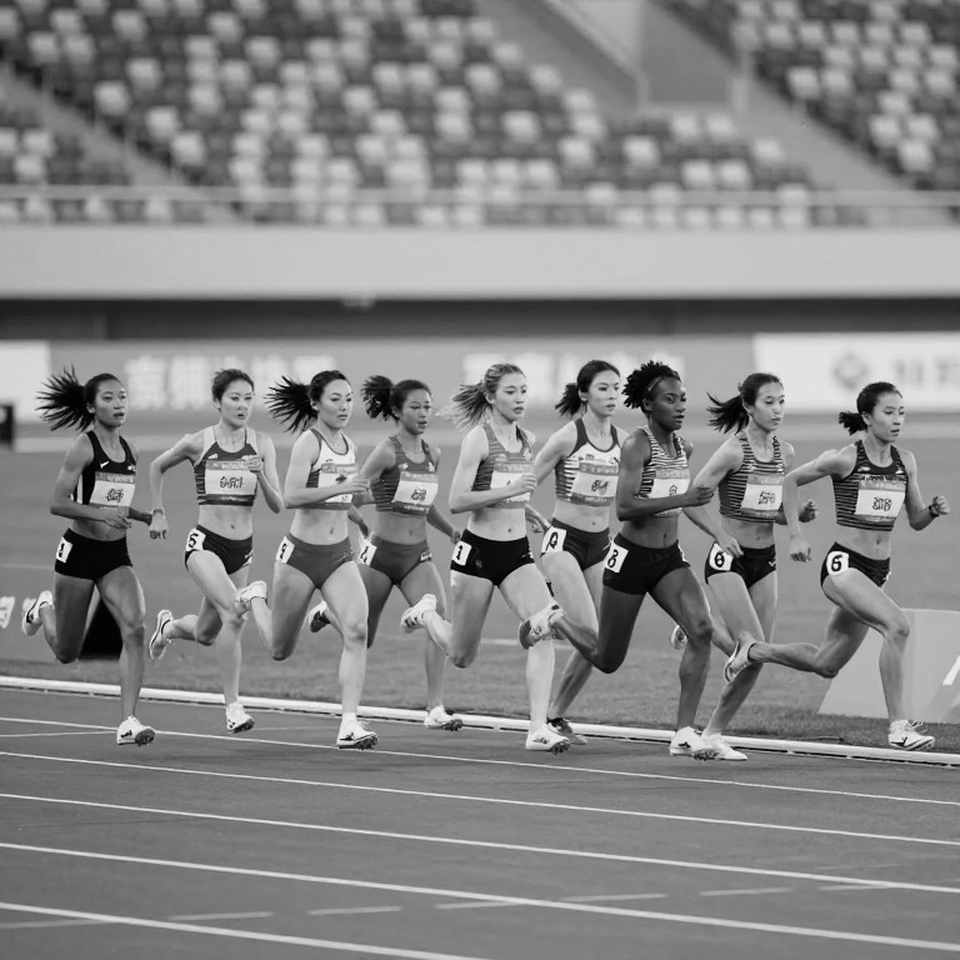
Here, the 0.08 seconds by which Vietnam trailed India has a very concrete technical meaning. In a relay, 0.08 seconds is roughly the time lost when a runner has to ease slightly to wait for the baton, or when the outgoing runner has to adjust stride by half a step. In other words, the distance between Vietnam's bronze and silver in this race fits inside one imperfect exchange.
That is good news and bad news at once.
The bad news is that it shows the team left something within reach. The good news is that it shows the team does not need a talent revolution to climb one step. It needs about two hundredths on leg four, and hundredths can be built by repeating one exchange drill a few hundred times in a training cycle.
On rules and anti-doping, there is no signal of any violation in the source data. The result was ratified, there were no protests, no sanctions, no equipment anomalies. That point matters, because in discussions about squads heavy with naturalised athletes, people slide easily from criticising structure to making false accusations. There is no evidence Bahrain broke any rule. An athlete of Nigerian origin competing for Bahrain after completing the required waiting period is entirely legal.
The legitimate debate is about policy, not individuals.
Four risks this bronze exposes
When analysing a positive result, there is a natural pull towards seeing only the positive. I want to do the opposite, because the value of analysis lies in identifying what can recur.
Risk one, high: the anchor leg. Vietnam led after three legs and was passed on the fourth. This is a repeatable failure mode, not an accident. It will recur in any final where opponents have a faster finisher. The fix is not replacing the runner, but developing a second female 400m runner below 52 seconds, so there is rotation and a contingency if someone is injured.
Risk two, high: the gold target concentrated in two events. With the mixed relay bronze secured, pressure shifts entirely onto the women's 4x400m, the women's 4x100m and the women's long jump. Any disruption in one of those three turns the Games from success into shortfall against the quota.
Risk three, medium: dependence on a veteran core. Quach Thi Lan and Nguyen Thi Ngoc are the two pillars of the relay. Both are in the middle or late phase of their peak career window. Without an incoming cohort in the 400m and 400m hurdles within two to four years, the squad loses much of the foundation that delivered the Aichi medal.
Risk four, medium: the data foundation. The source for this analysis names no publishing outlet, and one data point was corrupted. As an analyst I must state plainly that every figure here needs cross-checking against official Games results before any use.
The media narrative and the expectation gap
There is a pattern in how regional sports media covers results like this, and I have seen it repeat often enough to recognise it in advance.
The first phase is euphoria. A national record falls. A first athletics medal is won. The opponents beaten are large regional sporting nations. This is perfect material for a story of ascent.
The second phase, usually weeks or months later, is scepticism. People start comparing the mark to world standards. They discover that 3:14.54 is still about five to six seconds off the mixed relay world record. They discover Bahrain won by a margin that was not close. And the ascent story gets reread as a story about limits.
Both phases have a problem.
The real value of this result is that it is evidence of a threshold crossed, not evidence of a summit reached. A relay team going under 3:15 for the first time in national history is a real event. It is also a single run, and it says nothing yet about whether that threshold can be repeated.
My experience of regional athletics says the answer will come from the next meet, not from commentary. If this relay goes under 3:15 twice more in the next eighteen months, that is a trend. If not, it is a single peak from a well-prepared cycle.

I once mispronounced a name. The world kept turning. But their story cannot be misread a second time. At the 2026 World Cup I mispronounced Yerry Mina's name three times on live television and was mocked for days. I spent a month rewatching footage from all thirty-two teams to understand what I had missed. The lesson was not to be more careful with names. The lesson was that when one small detail does not fit, there is usually a larger structure behind it waiting to be seen.
A garbled "8 seconds" in the report on this relay is one such small detail. Behind it is a team that led and was caught.
Asian athletics is shifting along two opposing vectors
Placed in a wider frame, I see two forces acting on Asian 400m and relay events at the same time.
The first is naturalisation. Bahrain has proven that a modestly populated state can build a continental-class relay within a short cycle by recruiting athletes trained elsewhere. The model is entirely legal, and by competitive logic it will be studied and possibly copied. For countries pursuing an endogenous development path like Vietnam, that means the medal threshold will keep rising.
The second is relay specialisation. The mixed event needs only four people and rewards two good women plus two good men more than four uniformly decent runners. That makes the relay the most cost-effective medal channel for mid-tier federations. Vietnam chose the right channel, and concentrating 25 athletes into 16 events with a focus on relays and jumps is a rational allocation.
But specialisation has a price. It makes an entire sport's output depend on a few specific individuals. And it makes events like the individual 400m a secondary priority, when the individual 400m is precisely what supplies relay runners over the long term.
This is a loop I have seen in many small sporting systems across Asia and Oceania, including where I was born. You pour resources into the most medal-viable event, results improve, medal pressure rises, and funding for foundation events keeps shrinking. In three or four years you have medals. In eight or ten years you have a missing generation.
People only notice when it is too late to fix inside one cycle.
Signals to keep tracking
If I am still doing this job for a few more years, these are the markers I would write in my notebook to check back on.
The results of the two women's relays at these same Games, in the 4x400m and 4x100m. If either wins gold, the stated target is met and the media narrative looks very different from the alternative.
The composition of the mixed relay squad at the next international meet. If Nguyen Thi Ngoc still runs leg four and there is still no second female runner at a comparable level, the anchor problem remains unsolved, whatever that day's result.
The national record trajectory. A run under 3:14 within eighteen months would confirm Aichi as a milestone inside an upward trend. If the next mark falls back to 3:15 or higher, Aichi was a single peak.
And finally, Bahrain's squad composition at future Games. If their recruitment model is maintained and spreads to other federations, the medal door for endogenously developing nations will keep narrowing.
The next leg
The bronze in Aichi is a real result and deserves to be recorded at its true value. A Vietnamese relay ran 3:14.54, took nearly half a second off the national record, finished ahead of China and Japan, and won the delegation's first athletics medal of these Games.
But the most memorable moment of the race was not at the finish line. It was at 2:22.29, when Quach Thi Lan handed to Nguyen Thi Ngoc with Vietnam leading, and both the team and the crowd had to live through the next forty seconds with a question nobody could answer until the clock stopped.
Sport does not reward leading. It rewards finishing. A squad that learned that painfully in Aichi will be a more dangerous squad next time, provided it uses the interval between Games to find a second female 400m runner, rather than to retell the story of the near miss.
In the archive of the broadcaster where I once worked, I found a tape of the 2026 women's Asian championship final, where Japan lost to China. I interviewed former midfielder Akemi Noda by video call, and she told me she had once been barred from playing football simply for being a woman. When the world stopped during the pandemic, I started digging. And what I found was not in the record books.
Under the dust of old seasons, there are matches that never truly fell silent. The relay in Aichi, with its 0.08 seconds and an anchor that could not hold the lead, will be one of them. Not because it was beautiful. Because it showed Vietnam exactly the distance left between leading and winning, a distance small enough to be measured in one exchange, and large enough to take a generation to close.