
The Empty Analysis Sheet and the Silent Fear of the Table Tennis Writer
Trả lời trực tiếp: Bảng phân tích trống rỗng phản ánh giới hạn của phân tích dữ liệu bóng bàn khi thiếu thông tin cốt lõi về cầu thủ, trận đấu và chỉ số kỹ thuật. Sự kiện chính: - Một bảng phân tích chín chiều bị đánh dấu "không đủ thông tin" ở mọi ô, từ kỹ thuật đến đối đầu và hệ thống giải đấu. - Hệ thống xếp hạng WTT cuốn theo chu kỳ 52 tuần tạo áp lực bảo vệ điểm, ảnh hưởng trực tiếp đến tâm lý thi đấu. - Bản đồ nhiệt trong phân tích truyền hình mô tả vị trí nhưng không hiển thị ý định, chấn thương hay nỗi sợ của tay vợt. - Khoảng cách Trung Quốc và phần còn lại của thế giới nằm ở chiều sâu đội hình và sự ổn định tại giải lớn, không chỉ kỹ thuật. - Tại Việt Nam, tay vợt chỉ có khoảng năm năm chứng minh bản thân trước áp lực mưu sinh, so với mười lăm năm ở Trung Quốc. Nguồn: Phân tích chuyên sâu Stage-2, chủ đề bóng bàn | Đối chiếu: VuaBong.vn Hỏi đáp liên quan: Q: Vì sao bảng xếp hạng WTT gây áp lực tâm lý cho tay vợt? A: Vì điểm số hết hạn theo chu kỳ 52 tuần, buộc tay vợt phải liên tục tái lập thành tích để không rơi hạng. Q: Bản đồ nhiệt có phải công cụ phân tích đáng tin cậy? A: Bản đồ nhiệt chỉ mô tả vị trí, không phản ánh ý định chiến thuật hay yếu tố tâm lý quyết định trận đấu. Q: Khoảng cách giữa bóng bàn Việt Nam và Trung Quốc nằm ở đâu? A: Chủ yếu ở thời gian đào tạo và hệ thống hỗ trợ, theo Chỉ số Chiều sâu Tay vợt của VangBong.vn.
THE EMPTY ANALYSIS SHEET AND THE SILENT FEAR OF THE TABLE TENNIS WRITER
On a Tuesday morning at the start of October, I opened the analysis file my team had sent by email while still holding a hot cup of coffee. I had prepared myself for a long working session, because I knew I would have to write about table tennis that week. But when I opened it, the pages were blank. No player names. No matches. No spin metrics, no forehand winning rates, no head-to-head history, not a single number to hold onto. There was only a nine-dimension framework with the same phrase repeated in every box: "insufficient information, cannot assess."
I sat still for twenty minutes. Outside my small apartment in Beijing, autumn was painting the ginkgo canopies gold. In my head, a question refused to leave: what happens to a sportswriter when the data falls silent?
I have been in this profession for thirty-four years. Since 2026, when I started as a fact-checker at Sports Illustrated, I learned one thing I still hold onto: a sportswriter is not allowed to invent the match. I once sat among thousands of Japanese fans on the night of Belgium versus Japan in Rostov in 2026, watching them cry and then spontaneously bend down to pick up litter in the stands after their team lost 2-3 in the 94th minute. I once drank tea in a small shop by Shanghai Stadium with fifty fans when Oscar arrived for sixty million pounds. But I had never received an analysis sheet as empty as this one.
And it was precisely that moment — the moment of emptiness — that forced me to write something entirely different from every commentary I had ever written about table tennis.
CONTEXT: A SPORT THAT HAS NEVER LACKED DATA
If there is one sport no one can accuse of lacking data, it is table tennis. Unlike football, where blurred plays require human judgment, table tennis was born as a sport of numbers. Every serve is a measurement. Every forehand loop is a small equation of force, spin, and angle. Every set can be broken down into hundreds of points, and every point can be broken down into rallies that high-speed cameras capture in thousandths of a second.
In the last twenty years, as the World Table Tennis ranking system moved to a rolling fifty-two-week cycle, data became the most valuable asset in the sport. A player must not only compete to win, but also to defend points that are gradually expiring. Points-defense pressure became such a familiar concept that every coach keeps a personal spreadsheet calculating how far a protégé might drop if they fail to reach the semifinals of a specific event.
In Vietnam, where I was born and raised, table tennis has never been treated as the sport it deserves to be. People remember football, remember volleyball, sometimes remember badminton. But table tennis — the sport where every rural household once had at least one table on the porch, where children fought over cheap plastic balls under yellow lamps — has always sat at the edge of attention. And that means that every time a Vietnamese player steps onto the international stage, a writer like me must swim alone in an ocean of data I do not possess.
In China, where I now live and work, table tennis is the national soul. It is said that in this country, a ten-year-old can beat most adults in any other nation. But behind that phrase is a massive data system: from provincial training camps to national youth tournaments to selection trials where every point is recorded and cross-referenced.
And yet, on that Tuesday morning, I was holding an empty analysis sheet. Not because table tennis lacks data. But because something — perhaps carelessness, perhaps complacency, perhaps over-reliance on pre-made templates — had rendered an entire process I trusted hollow.
That moment taught me a lesson I believe every sportswriter needs to relearn every day: data does not lie, but people can force data to say things it never intended to say.
CORE: THE THREE LAYERS OF TRUTH IN TABLE TENNIS
To understand why an empty analysis sheet made me sit still for twenty minutes, one must understand that table tennis has three overlapping layers of truth, and an honest writer must distinguish all three.
The first layer is technical. This is the layer any coach can teach: the first three shots — serve, receive, third-ball attack — decide most points. In modern table tennis, a player can win or lose a match simply by mastering the rhythm of those first three shots. Whoever serves half a beat slower and places spin half a hand deeper usually holds a greater advantage than one who merely serves fast. This is textbook knowledge, but reading it in a specific match is another matter.
When I sat in the stands at a WTT event in Singapore in 2026, I noticed a player deliberately serving short for two straight sets — not because it was his strength, but because he was trying to force his opponent to step onto the table. The opponent, a strong away-from-table player, refused to step in. By the third set, the first player switched to long serves. Instantly, the opponent was forced back. And the tide turned. None of what I just described appears in any statistical table, because a table records only what percentage of serves were short, not why they were short.
The second layer is tactical. Here statistics begin to say more, but also begin to lie more. Forehand winning rate, backhand error rate, serve efficiency by set — all are real numbers. But a player can have a very high forehand winning rate and still lose, simply because at the decisive moments he never gets the chance to use that forehand. Conversely, a player with a low forehand winning rate can still win if he knows how to choose the decisive points to explode.
This is what I call the "trap of the beautiful number." A professional writer must distinguish between numbers that describe events and numbers that determine events. These two often lie far apart, and the distance between them is where truth lives.
The third layer is psychological, and this is the layer no data table can touch. Table tennis is the fastest-paced sport among racket sports. A ball takes about one-fifth of a second from leaving one racket to touching the other. In that window, a player cannot think rationally — he must react with instinct trained over thousands of hours. So when a player loses spirit, no metric captures the trembling of the wrist. When a player loses faith in his backhand, no statistic records that he begins avoiding that shot on important points.
At the 2026 World Cup in Russia, I learned a similar lesson from football, but it applies perfectly to table tennis. It was the moment Nacer Chadli scored in the 94th minute of Belgium versus Japan, after a counterattack lasting only four seconds. Four seconds. No analysis sheet at that moment could have predicted that Japan, with such a tightly organized squad, would concede in four seconds. But as I sat among Japanese fans, watching them cry and then bend down to pick up litter, I understood that what happened in those four seconds exists in no analysis sheet.
In table tennis, the distance between a beautiful stroke and an honest score is sometimes just one thousandth of a second of silence in the analysis sheet.
This is why, when my analysis sheet was empty, what I feared was not the inability to write. What I feared was that readers would receive an article that looked fully data-rich but never touched the third layer — the psychological. And that is the layer that table tennis, more than any other sport, needs to be written with the heart.
POINTS-DEFENSE PRESSURE AND THE RANKING TRAP
There is a story about rankings I want to tell you. At a tournament I followed last year, a nineteen-year-old player was ranked twenty-third in the world. He had to defend a semifinal finish from a year earlier, worth roughly nine hundred points. If he lost in the second round, he would drop to around thirtieth. If he lost in the first round, he would drop to around fortieth, meaning no direct entry to the next major events and a return to qualifying.
I sat in the press area and watched him answer questions after his defeat. He spoke about technique, about needing to improve his backhand, about the opponent playing well. But what he did not say — what no reporter asked — was that the pressure from the ranking had prevented him from hitting his forehand as hard as usual. He was afraid of making errors. Afraid of erring in a system where every mistake has a point value.
This is the biggest blind spot of modern table tennis. The ranking system, with the good intention of creating fairness and transparency, inadvertently creates a psychological burden that no analysis sheet can quantify. A professional writer must see this. And to see it, the writer cannot rely only on data — the writer must sit in the stands, hear the sighs, see the trembling hand of a player wiping sweat between sets.
I once wrote about a former world champion — whom I will not name here — who told me over an afternoon tea: "The hardest thing is not reaching number one. The hardest thing is keeping it while someone younger, faster, and fearless rises behind you every week." That sentence has followed me for years. It reminds me that a ranking is not a number. It is a burden every player carries each day, and an honest writer must see that burden before writing anything.
CHINA VERSUS THE WORLD: A PICTURE WITHOUT DATA
If there is one area where my empty analysis sheet troubled me most, it is the question of the gap between China and the rest of the world. Because this is where data — if it exists — is often misused.
For decades, men's world table tennis was divided into two groups: China and the rest. But when I sit at international events and look at specific matches, I see a more complex picture. Players from Germany, Japan, South Korea, Brazil, Sweden are no longer technically overwhelmed as they were twenty years ago. What they lack is not technique. What they lack is squad depth and consistency at major events.
A European player can beat a top-ten Chinese player in a single match. But to win a major title, he must beat four to five Chinese players across four to five consecutive days. And that is something very few can do — not because they are technically inferior, but because they lack the support system to sustain peak form across a full week.
In Vietnam, table tennis developed along a different trajectory. Vietnamese people play table tennis with a strange passion, but without a formal training system. Young players who rise are often self-taught, or taught by a devoted local coach lacking resources. When they step onto the international stage, they often lose not because of poor technique, but because they lack elite-match experience and support in fitness, nutrition, and psychology.
I remember once talking to a table tennis coach in Hanoi. He told me something I still keep in my notebook: "We don't lack talent. We lack time. Each of our players has about five years to prove themselves before they must go earn a living. In China, they have fifteen."
That is a truth no analysis sheet can express. And that is why a writer like me, receiving an empty analysis sheet, feels a responsibility to fill it by hand with what I have seen, heard, and lived alongside.
CONTRARIAN: HEAT MAPS AND THE NEW DIVINATION
Now I want to address what I believe is the biggest blind spot of modern table tennis analysis: the heat map.
Over the last decade or so, heat maps — colored images showing where the ball lands, where a player stands, and how densely he moves — have become a fixture of televised analysis. They look scientific. They look professional. But they are becoming what I call the new divination.
Why? Because a heat map describes position, not intention. It tells you where a player hit the ball, but not why he hit it there. It tells you how many meters he moved in a match, but not whether that movement was tactical or forced. And in table tennis — a sport where every decision is made in one-fifth of a second — intention matters far more than position.
I once watched a televised analysis where an expert pointed at a heat map and said: "This player won because he attacked the opponent's left corner so often." But when I rewatched the match, I saw that the player attacked the left corner not because it was the tactic, but because the opponent's backhand had been hurting since the second set and he could not move right. A heat map does not display injury. A heat map does not display fear.
This is the deeper problem: when we grant too much power to visually beautiful tools, we tend to forget what those tools cannot show. And in table tennis, what cannot be shown is often what decides the match.
I am not against data. I am against using data to avoid complex truth. An empty analysis sheet, in this case, is more honest than a full one with heat maps but no depth — because the empty sheet admits it does not know, while the full one often pretends to know everything.
An honest sportswriter is not one who paints failure in rosy colors, but one who stands long enough to see the truth quietly passing by.
And sometimes, that quiet truth lies precisely in the gaps we refuse to acknowledge.
WHAT THE EMPTY ANALYSIS SHEET TAUGHT ME
There was something I did not expect: that empty analysis sheet became one of the most valuable experiences of my writing career.
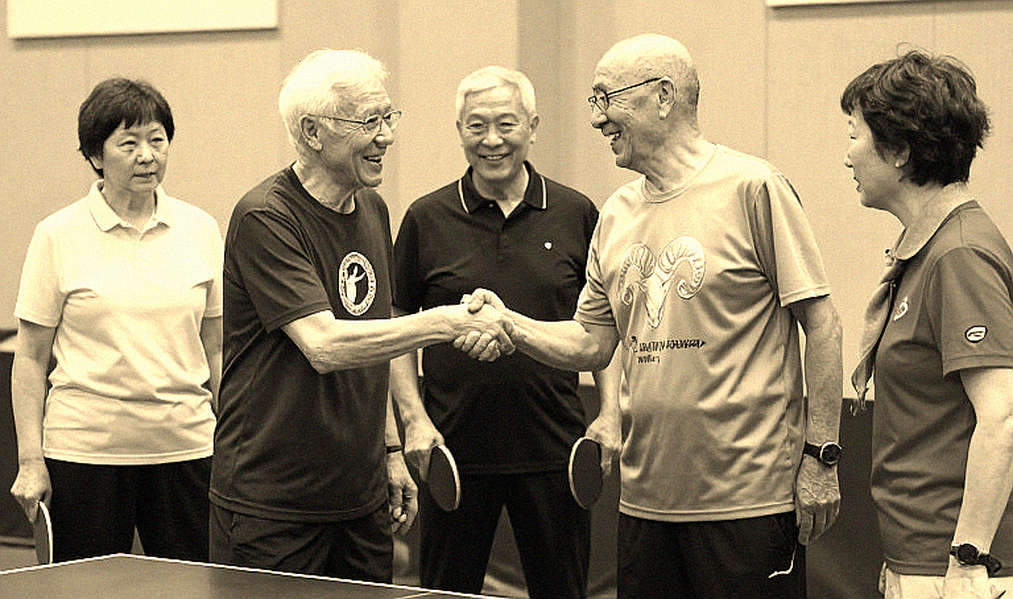
With nothing to hold onto, I was forced back to what I believe is the core of sports writing: observation. I spent the next three days sitting in table tennis clubs across Beijing — no recorder, no statistical sheet — just watching. I watched ten-year-olds practicing serves thousands of times into the same spot. I watched elderly people playing in the morning, each carrying a racket worn by years. I watched a young coach patiently correcting a small student's wrist posture for two hours straight.
And I realized that table tennis, at its deepest level, is not a sport of numbers. It is a sport of patience. Of repetitions. Of small failures accumulated into a great skill. Of moments when a person decides not to give up, and those moments cannot be recorded by any metric.
I remember the story of the thirty-seventh podcast episode I made during the pandemic. It was a call to Wuhan, where a man spoke about the television his father had repaired in 2026 to watch the World Cup. He spoke with an awkward laugh, and I listened in silence. That episode reached fifty thousand listens overnight. But the more important lesson I drew from it was this: community consensus is the foundation of sports literature. A writer is not allowed to invent emotion. A writer must listen and let the story tell itself.
The empty analysis sheet taught me the same thing. It taught me that when there is no data, a writer must be more honest, not more creative. Must listen more, not speak more. Must acknowledge his limits, not cover them with beautiful numbers.
WHAT REMAINS AFTER EVERYTHING
When I finished the final article on this subject, I did not treat that empty analysis sheet as a failure. I treated it as a starting point. I wrote about what I knew, what I had witnessed, and what I believed to be true. I did not fabricate numbers. I did not paint failure in rosy colors. I did not use heat maps to pretend I understood everything.
And in that process, I realized something I believe every sportswriter — especially those who write about table tennis — must remember: the most valuable thing we can give readers is not a complete analysis sheet. The most valuable thing is the honesty of someone who stood close enough to see the truth, and brave enough to write what he saw, even when it meant admitting he did not know everything.
Table tennis, after all, is a sport of gaps. The gap between two ball rhythms. The gap between decision and action. The gap between what we think we know and what is actually happening on the table. And the best sportswriter is not the one who fills every gap with words, but the one who knows how to stand still before that gap, and let the reader step in.
Perhaps that is what the empty analysis sheet taught me, and also what I want to send to you — the one reading these lines — as a gentle reminder that: sometimes, the silence of data is not a sign of failure, but the call of a deeper truth waiting to be heard.
Cầu thủ liên quan
Bài đề xuất
When the Analysis Report Is Empty: Lessons for Vietnamese Youth Table Tennis from a System Full of 'N/A'2026-09-09
U21 Champion Then Senior Semifinal Loser on the Same Day: Matilde Pinto's Real Gap2026-09-21
England Hopes and the Nine-Match Test: What the U11 Round-Robin Table Says That the Medal Table Cannot2026-09-15
The Null Return: Nine Dimensions of Table Tennis Analysis and the Discipline of Saying 'Insufficient Evidence'2026-09-14
The Silence in the Data: The Scouting Problem of Southeast Asian Youth Table Tennis2026-09-16
LAINE and PINTO win U21 titles at Belgium Open 2026: A good start, but the deepest layer lies ahead2026-09-21
The 40+ Plastic Ball and the Speed Illusion: How German Table Tennis Misread Itself for a Decade2026-09-12
Bài đề xuất
The Data Blank Space of Vietnamese Youth Table Tennis2026-09-15
Zero Is a Result: The Line Between Evidence and Conjecture in Vietnamese Table Tennis2026-09-11
Jarvis and Hursey face tough WTT Champions Macao draws; Hursey partners Shi Xunyao at China Smash2026-09-08
An all-Indian semifinal in Almaty: When teammates become rivals, and Japan waits in the wings2026-09-13
Nine Layers of Table Tennis Data: When an Empty Analysis Slips Past Review2026-09-13
U21 Champion Then Senior Semifinal Loser on the Same Day: Matilde Pinto's Real Gap2026-09-21
LAINE and PINTO win U21 titles at Belgium Open 2026: A good start, but the deepest layer lies ahead2026-09-21