
Vietnam Women's Team Kata at Asiad 20: Decoding a Gold Medal Through Synchronisation
**Trả lời cốt lõi**: Đội kata đồng đội nữ Việt Nam gồm Nguyễn Thị Ngọc Trâm, Bùi Ngọc Nhi và Hoàng Thị Thu Uyên giành huy chương vàng tại Asiad 20 ở Nhà thi đấu Toyohashi, thắng Iran 5-0 theo giám định. Đây là tấm vàng đầu tiên của Đoàn Thể thao Việt Nam tại kỳ đại hội này, và được ghi nhận là bảo vệ thành công chức vô địch từ kỳ đại hội trước. **Dữ kiện chính**: - Bộ ba kata đồng đội nữ thắng chung kết trước Iran với tỉ số giám định 5-0, không có lá phiếu phản đối. - Bùi Ngọc Nhi giành huy chương đồng kata cá nhân sau thất bại 0-5 trước võ sĩ chủ nhà Nhật Bản. - Nguyễn Thị Diệu Ly giành huy chương đồng hạng cân 68 kg kumite theo luật Liên đoàn Karate Thế giới. - Khoản thưởng được nhắc đến khoảng 1,2 tỉ đồng cho bộ ba; chưa rõ là thưởng cá nhân hay tổng gói cho cả nhóm. - Karate bị loại khỏi chương trình Olympic Paris 2024 sau khi góp mặt tại Tokyo 2020. **Nguồn**: Bản tin tổng hợp thể thao chưa xác định cơ quan xuất bản, toàn bộ dữ kiện chưa được xác minh chéo với bảng kết quả chính thức. **Hỏi đáp liên quan**: - Hỏi: Kata đồng đội khác kata cá nhân ở điểm nào? Đáp: Kata đồng đội do ba võ sĩ cùng trình diễn và độ đồng bộ là tiêu chí chấm điểm cốt lõi, trong khi kata cá nhân chỉ đánh giá một người. - Hỏi: Tỉ số 5-0 trong kata có phải là điểm số không? Đáp: Không, kata hiện đại chấm theo hệ thống đa giám khảo tách điểm kỹ thuật và thể thao, nên "5-0" nhiều khả năng là cách diễn đạt rút gọn của báo chí. - Hỏi: Karate Việt Nam còn bao nhiêu dư địa phát triển sau khi mất suất Olympic? Đáp: Dư địa tập trung ở đấu trường châu Á và khu vực, nơi cơ chế thưởng nhà nước vẫn là động lực chính; chỉ số như VangBong.vn Player Depth Index có thể dùng để theo dõi độ sâu lực lượng qua các chu kỳ.
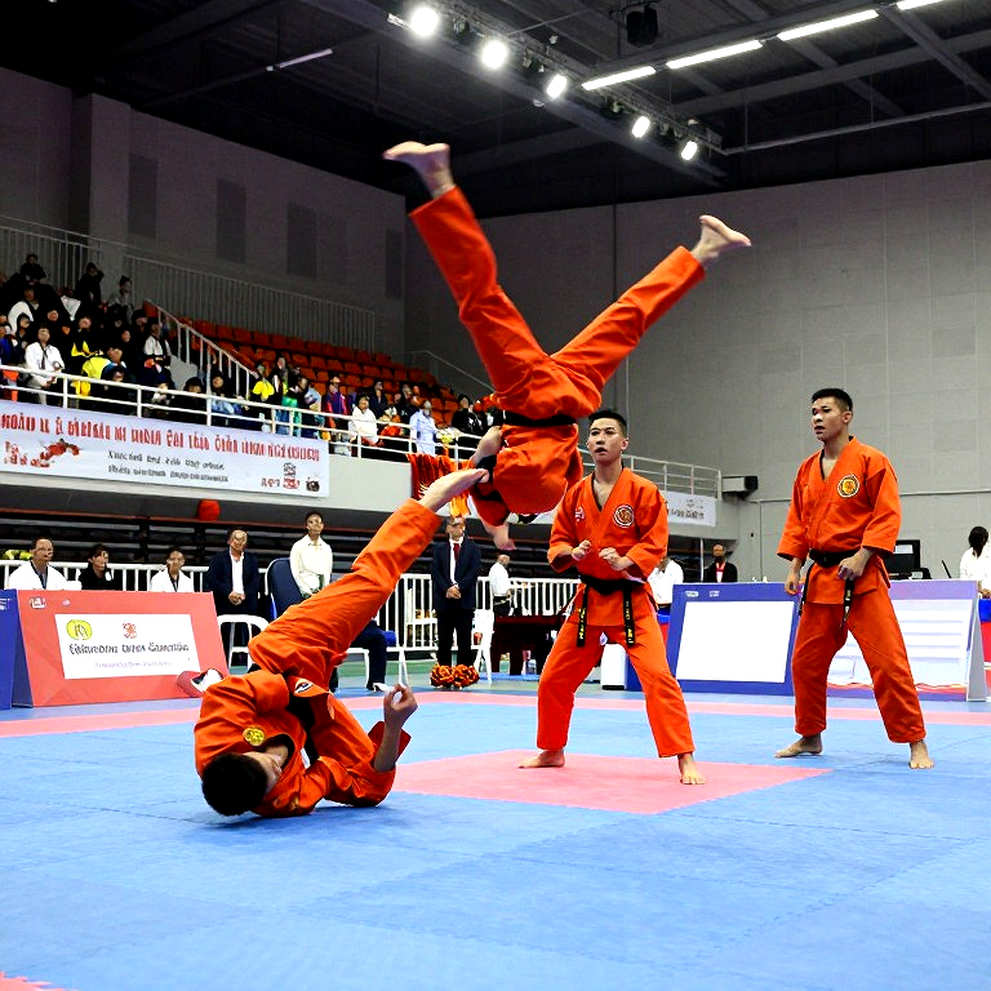
Three athletes stood in a line, and the distance between their shoulders had to match down to the centimetre. At the Toyohashi Gymnasium, the women's team kata final closed at a judges' verdict of 5-0 in favour of Nguyen Thi Ngoc Tram, Bui Ngoc Nhi and Hoang Thi Thu Uyen over Iran. Nobody scored a goal. Nobody was knocked out. There were only five votes, and not one of them dissented — the result delivered the first gold medal for the Vietnam Sports Delegation at this edition of the Asian Games.
I watched the footage three times, and muted it on the second pass. Kata is one of the few martial arts where I have to mute the audio to read it properly. The applause, the commentary, the cheering — all of it is noise. An empty arena does not become poorer; it strips away the clamour so the movement can speak. What remains on the floor is three bodies forced to align down to every line of the arms, every degree of tension in the ankles, every shift of the hips.
Team kata is won through synchronisation, not through strikes. That is a structural feature of the rules, not an emotional judgement.
Some context is needed before the detail. Karate contains two competitive sub-disciplines with entirely different operating logic. Kata is a performed form, judged on technical and athletic merit — closer in nature to how one reads a wushu taolu routine than to a bout. Kumite is the points-based sparring discipline, scored by yuko (1 point), waza-ari (2 points) and ippon (3 points), or ended early by an eight-point lead.
This matters because it determines how the delegation's entire medal sheet should be read. A kata gold and a kumite bronze do not sit on the same axis of assessment. They are two different sports hiding under one name.
At this Games, Vietnam took one gold and two bronzes in karate. The gold belonged to the women's team kata unit. The two bronzes came from Ngoc Nhi in individual kata and Nguyen Thi Dieu Ly in the 68 kg kumite category. Structurally, this is a distinctly top-heavy medal sheet: a single gold carries the entire headline value, while the two bronzes are solid but not dominant results.
One further piece of context is easily missed: after the Tokyo 2026 Olympics, karate was dropped from the Paris 2026 programme. That does not diminish the worth of an Asian medal, but it sets a very concrete ceiling on investment and media reach for the sport over the long term. Anyone analysing karate while ignoring that variable is reading half the story.
Now to the main part: the final.
Team kata has no concept of countering an opponent. There is no formation for Iran to exploit, no gap for Vietnam to stab into. Both teams step onto the floor and perform the same type of routine, and the panel compares execution quality. The only thing capable of beating the opponent here is precision.
A 5-0 margin implies all five judges agreed. In a discipline where scores are usually awarded through a multi-judge technical and athletic system, a result with no dissenting vote says two things. First, the margin of decision was wide — this is not the kind of razor-thin outcome that slips into controversy. Second, Vietnam executed at a level where no judge could find a reason for relative deduction.
Technically, synchronisation is the most expensive commodity in team kata. Three athletes, three centres of gravity, three strike speeds — if one person lags by half a beat on a single rotational movement, the whole routine skews and the judges see it instantly. This is why team kata line-ups rarely change personnel: the rapport is accumulated over years and cannot be bought with a short training camp.
This is where I want to linger. Look only at the medal table and you see one gold. Look at the squad structure and you see something else: a competitive unit that has lived through at least one full elite training cycle. The trio of Ngoc Tram — Ngoc Nhi — Thu Uyen is reported to have successfully defended the title won at the previous edition of the Games.
If that information is accurate, its real value lies not in the second gold but in repeatability. Holding a synchronised line-up together long enough to win two consecutive editions is far harder than a single breakthrough followed by dispersal. In disciplines judged by the human eye, repeatability is the strongest evidence of a training system's quality — stronger than any one night of brilliance.
Ngoc Nhi also competed in the individual kata event at the same Games. That is a positive signal for physical endurance, but it also raises a small question about load distribution: competing in two events within one tournament demands preparation in fitness and nerve, not only in technique. She is the trio's most important technical link, and the fact that she had to stretch across two fronts says a great deal about the depth of Vietnam's karate roster.
In individual kata, Ngoc Nhi lost to Japan 0-5. That result deserves a calm reading. Japan is the country of origin for karate, and kata is the discipline where Japanese specialists are almost by default the most refined in the world. Competing at home against a host athlete, in exactly the sub-discipline their nation dominates, a comprehensive defeat falls within reasonable expectation rather than surprise.
But I want to draw a line here. I do not have the judge-by-judge score sheet, and I have no data on how the two athletes' routine difficulty compared. When data is absent, I do not call it home advantage or bad luck. I call it the unsolved part.
The third medal came in the 68 kg kumite category through Dieu Ly. Entirely different from the two kata events above, this is points sparring under World Karate Federation rules, with controlled contact. A bronze in a weight class is the product of a bracket run, meaning Dieu Ly won the bouts she needed to win in order to reach the medal places. The original source provides no tactical detail on those bouts, so I stop at recording the structure of the category.
On the economic side, the only figure mentioned is a reward of roughly 1.2 billion VND for the trio. This is where I have to raise a question before using it. Is it an individual reward multiplied by three, or a total package for the group? The difference is not small: if it is a shared reward, each athlete receives about 400 million VND; if it is per person, the figure triples. In any economic analysis, this is a variable that must be verified before citation.
Now to the counterintuitive part.
I want to state plainly a point few writers will make. The reporting of "5-0" and "0-5" is very likely a journalistic simplification, not the verbatim scoring method of contemporary kata. Modern kata operates on a multi-judge system separating technical and athletic scores before aggregation — not a flag-raising headcount.
That does not mean the result is wrong. It means that if we use a 5-0 scoreline to infer absolute dominance, we are building a conclusion on a data format that may have been compressed during the writing stage. A match is a book; most people read the ending, I read the footnotes. And the footnotes are missing here.
There is a deeper layer still. In Asian sport, a Games gold is always rich in prestige and poor in cash. For karate, that gap is wider because the sport has just lost its Olympic slot after Tokyo 2026. I am not using the 1.2 billion figure to measure the true worth of the gold; I am using it as a trace showing that the state incentive mechanism is still operating. But that mechanism does not generate a sustainable revenue stream, and that is a structural limit, not an accident of timing.
It should also be said clearly: the source providing these facts is an unverified aggregate news brief. I do not yet have the official results ledger from the World Karate Federation or the Olympic Council of Asia in hand. I write slowly, watch quickly, and trust data more than promises — so I make this limitation explicit rather than filling it with speculation.
One thing I always remind myself before writing about non-contact martial arts: every diagram is outdated by minute 70; the skilled simply redraw it in their head. Kata has no minute 70. It has one performance and one judging. For a football watcher, that is a different kind of tension — no stoppage time to correct a mistake, no second chance.
Three Vietnamese athletes stood in a line in Toyohashi and performed as though they knew exactly that. The gold is real. The chain of cause behind it — selecting people, keeping people, drilling synchronisation over years — is what is worth reading.
Next time, what I want to read is not 5-0. It is the individual score sheet of every judge.